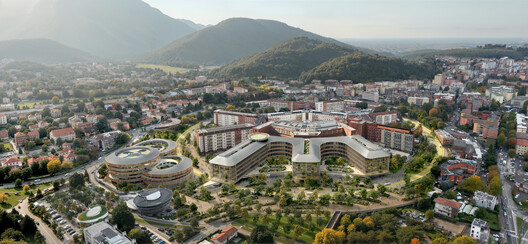
The project developed by CRA-Carlo Ratti Associati, Park Associati, Politecnica Building for Humans, Openfabric, DOTDOTDOT, Studio Mattioli, and Eckersley O'Callaghan has been selected to design the new Main Hospital and Children's Hospital in Brescia, Italy. The international competition mandate was to redevelop an existing hospital, preserving and extending a radial plan conceived by engineer Angelo Bordoni in the early twentieth century. The existing healthcare complex, Spedali Civili di Brescia, follows a hexagonal masterplan and radial layout that informs the new design for the premises. The geometry is reinterpreted to update the campus for future models of care, drawing a new CareRing around it that connects people, nature, and healthcare through the principles of One Health, the idea that human health, environmental health, and social wellbeing are inseparable.
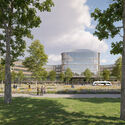
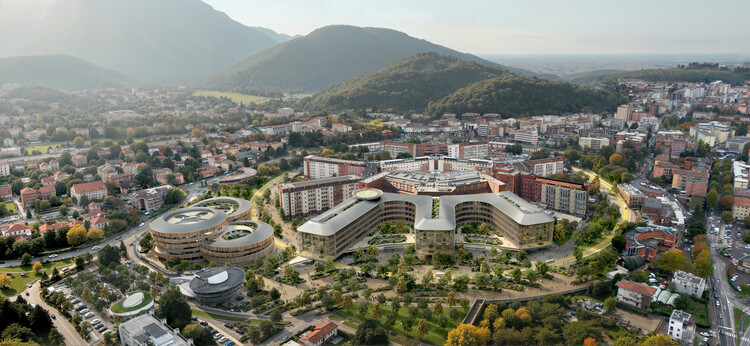
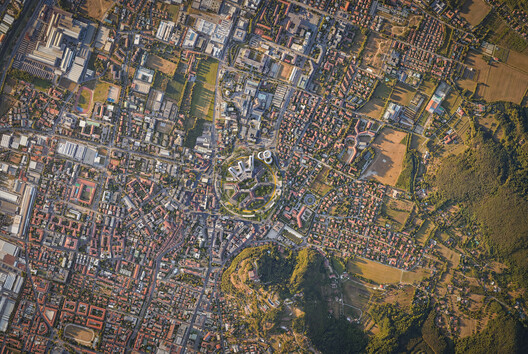
The new Main Hospital and Children's Hospital draw a ring of more than one kilometre around the existing healthcare campus, functioning as a landscape infrastructure connecting it to the city. Below ground, the CareRing accommodates logistics, technical infrastructure, and hospital services, separating operational flows. At ground level, it becomes a public landscape connecting squares, therapeutic gardens, and green corridors, designed by Openfabric to support biodiversity, improve the site's microclimate, and connect the hospital to the surrounding city. The project's defining spatial concept is that patients, staff, and visitors can move as freely through gardens and public spaces as through the buildings themselves.
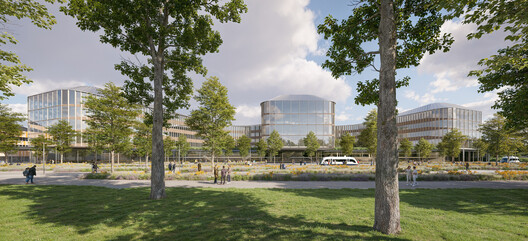
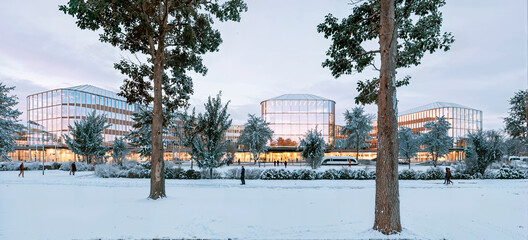
The renovated complex is envisioned as an integrated public infrastructure. The One Health approach translates into a unified strategy bringing together healthcare, education, research, and landscape within a single organism conceived to adapt over time. The historic pavilions are expected to be progressively transformed into spaces for academic activity, research, and innovation, reinforcing the links between clinical practice, education, and the wider community. The new project is also expected to strengthen ties with the Faculty of Medicine at the University of Brescia. The hospital's clinical and technological functions will be concentrated within the new facilities, providing a total of 60,500 sqm of floor space and more than 745 beds.
Related Article
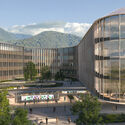
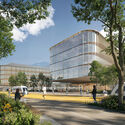
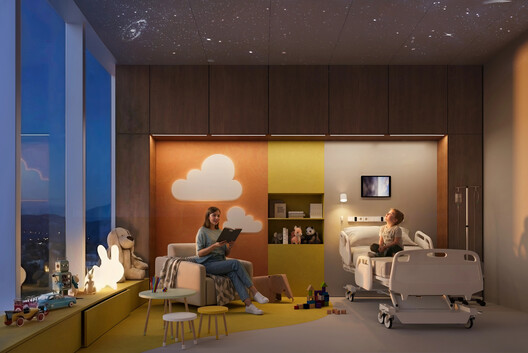
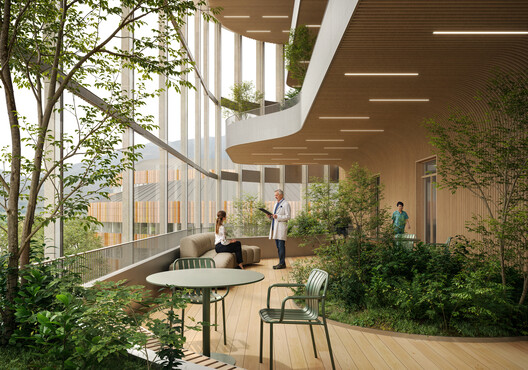
Architectures of Care: Healing Spaces Across CulturesThe Main Hospital is organized around three interconnected wings that follow the radial logic of the existing complex. At ground level, a continuous glazed lobby overlooks a new public square, opening the complex towards the city. The internal layout applies the principles of Healing Architecture through daylight quality, acoustic comfort, balanced spatial proportions, and framed views towards the Brescia Prealps. The ends of each wing are designed as glazed winter gardens, reducing the perception of enclosure, and visual connection with the landscape is considered an integral part of the healing process. Clinical services are reorganized to streamline circulation, reduce travel distances, and improve operational continuity, while the building envelope is designed as both an active instrument of climate regulation and a defining architectural feature.
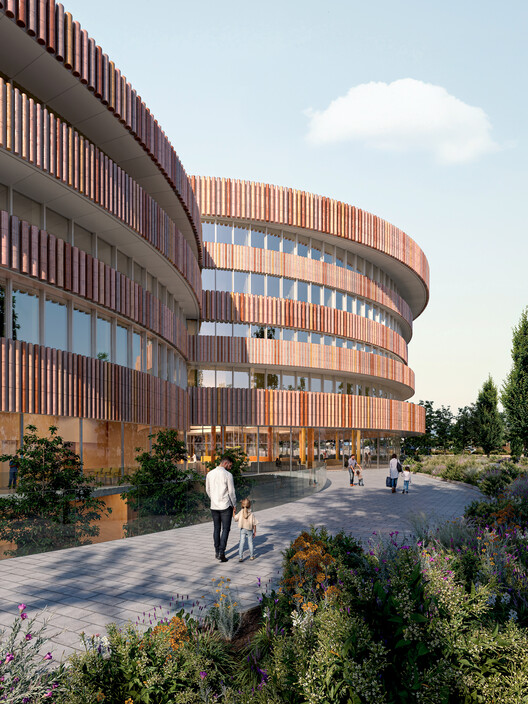
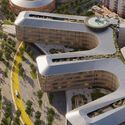
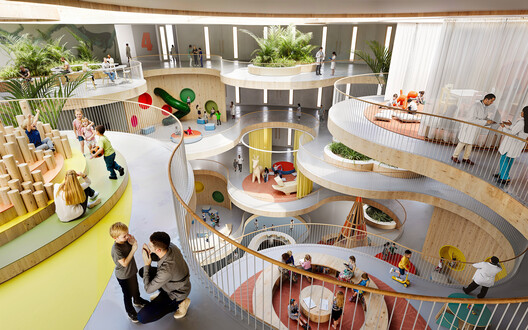
The Children's Hospital is composed of three cylindrical volumes of varying heights, with a system of terraces and internal courtyards. An entrance lobby organized around a full-height atrium serves as a social space, accommodating play areas and consultation zones within a protected environment. Both hospitals are designed with a hybrid timber-and-steel structure assembled using dry construction techniques, following a modular system capable of accommodating future reconfiguration alongside advances in medical technologies and models of care. This structural approach aims to reduce embodied carbon and shorten construction time. Intelligent wayfinding systems, flow management, and environmental monitoring are integrated into the design to support the re-engineering of everyday healthcare processes.
Construction is expected to begin in 2028. In parallel, CRA is developing a new project for INOC — Istituto Nazionale Oncologico Candiolo in Turin, a cancer center that integrates scientific research and treatment. Both projects share a vision of healthcare connected to landscape through the One Health approach, transforming parking areas, rooftops, courtyards, and entrances into spaces for productive landscapes, biodiversity, renewable energy, and informal interaction. Together, they represent a broader ambition: hospitals that are less isolated from their surroundings and more deeply connected to nature, research, and everyday urban life.
A similar approach has been developed by Renzo Piano Building Workshop for the Hôpital Universitaire Saint-Ouen Grand Paris Nord (HUSOGPN) in France, envisioned as a "hospital-landscape" featuring a 1.3-hectare roof garden and an urban forest with over 1,000 trees. In Africa, Kéré Architecture has designed a new healthcare center in the Bubanza region of Burundi, combining locally sourced materials, traditional craftsmanship, and knowledge transfer. Aino and Alvar Aalto's Paimio Sanatorium, a recognized example of modern architecture for healing, is being renovated and transformed into a destination combining hospitality, wellness, cultural spaces, and arenas for international dialogue by Snøhetta.


