Building Calories: Moving Beyond Greenwashing to Investigate the Value of Living with Plants

Subscriber Access

In 2013 ArchDaily published the article “Can We Please Stop Drawing Trees on Top of Skyscrapers,” - its author was frustrated by rampant greenwashing. If you wanted it to look sustainable, you’d just have to put a tree on it. Plants have always been an effective marketing tactic to appeal to the environmentally conscious, but as soon as they are photoshopped in, they are often discarded at the first whiff of value engineering. Given the voluminous flurry of vigorous commentary and debate following that publication (2013, 2016, 2016) it is clear there is something that persists, perhaps a widely felt instinct that in truth, our urban “landscapes” are unsustainable, and often unlivable. Our cities not only take advantage of the ecosystem services of far-off forests and groundwater to support our carbon production, air pollution, and water wastage, exhausting arable land to feed our increasingly urban populations but simultaneously create urban areas devoid of life that increase our carbon footprints and negatively impact human health and well-being.
Building Calories: Moving Beyond Greenwashing to Investigate the Value of Living with Plants - Image 2 of 5Building Calories: Moving Beyond Greenwashing to Investigate the Value of Living with Plants - Image 3 of 5Building Calories: Moving Beyond Greenwashing to Investigate the Value of Living with Plants - Image 4 of 5Building Calories: Moving Beyond Greenwashing to Investigate the Value of Living with Plants - Image 5 of 5Building Calories: Moving Beyond Greenwashing to Investigate the Value of Living with Plants - More Images

Content Loader

Image gallery

See allShow less
About this author
Cite: Andreas Theodoridis, Christina Ciardullo & Anna Dyson. "Building Calories: Moving Beyond Greenwashing to Investigate the Value of Living with Plants" 15 Dec 2022. ArchDaily. Accessed . <https://www.archdaily.com/993515/building-calories-moving-beyond-greenwashing-to-investigate-the-value-of-living-with-plants> ISSN 0719-8884
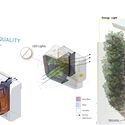
The first installation of the Active Modular Phytoremediation System (AMPS) in the Public Safety Answering Center II (PSAC II), in the Bronx, in New York, USA represents a first of it’s kind system integrated with building HVAC to facilitate the regeneration of fresh air from within the building. Image © Yale CEA/SOM/AMPS, Image Courtesy of Skidmore, Owings & Merrill-SOM

建筑热量:超越漂绿,探究与植物共生的价值

You've started following your first account!

Did you know?

You'll now receive updates based on what you follow! Personalize your stream and start following your favorite authors, offices and users.