

-
Architects: Martin Schmidt Radic Arquitectos Asociados
- Area: 9500 m²
- Year: 2015
-
Manufacturers: CHC, Carpenter, Concret Doctor, Dryconing, Hunter Douglas, +1
-
Professionals: Bravo e Izquierdo, Ingeconstur



.jpg?1444826709&format=webp&width=640&height=580)

In a Los Angeles Times article last December, “The future is in the past: Architecture trends in 2014,” acting critic Christopher Hawthorne sought to make sense of a year that included Koolhaas’s Venice Biennale, Smiljan Radic’s Serpentine Pavilion, and periodicals like Log 31: New Ancients and San Rocco 8: What’s Wrong with the Primitive Hut? Through these examples and others, Hawthorne concluded that it was a year of overdue self-reflection, where in order to determine architecture’s future it was necessary to mine the past.
Building on these precedents, Hawthorne predicted that after years of baroque parametricism, in 2015 architects would use last year’s meditations on history as a practical foundation for new projects and proposals. An example of this can be found in the work of Michael Ryan Charters and Ranjit John Korah, a duo who recently shared the top-five prize for the CAF led ChiDesign Competition (part of the Chicago Architecture Biennial) for their project Unveiled. In a brief that called for “a new center for architecture, design and education,” and with lauded jurors including Stanley Tigerman, David Adjaye, Ned Cramer, Monica Ponce de Leon, and Billie Tsien, Charters and Korah proposed what could casually be summarized as a terracotta framework over a multi-story crystalline form of wooden vaults, but is actually something much more complex.


.jpg?1443667335&format=webp&width=640&height=580)

.jpg?1443794805&format=webp&width=640&height=580)
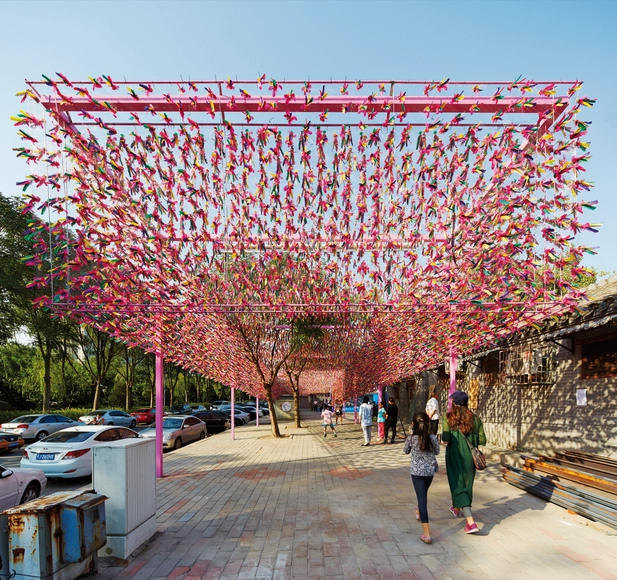
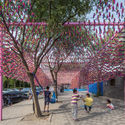
Text description provided by the architects. Following up a year of development, Penda has unveiled their installation for Beijing Design Week (BJDW) 2015 – Rising Canes, a structural system made entirely of bamboo and ropes. Meant to be a speculation system for larger developments, the installation is fully modular, ecological and easy to expand in every direction. Bamboo was chosen as the main construction material for its long traditional roots in China and fantastic structural capability, as well as part of a desire to fight its current obscurity as a construction material.
.jpg?1443036354&format=webp&width=640&height=580)









.jpg?1444826644 "Courtesy of SABO project")
.jpg?1444826758 "Courtesy of SABO project")
.jpg?1444826928 "Courtesy of SABO project")
.jpg?1444826792 "Courtesy of SABO project")
.jpg?1444826709)


















.jpg?1443668099 "© Luc Boegly")


.jpg?1443667804 "© Luc Boegly")
.jpg?1443667335)






.jpg?1443795381 "Speculation of Future Developments. Image Courtesy of Penda")
.jpg?1443795335 "Speculation of Future Developments. Image Courtesy of Penda")
.jpg?1443794787 "© Hua Su")
.jpg?1443794843 "© Xia Zhi")
.jpg?1443794805)
.jpg?1443036690 "© Kevin Scott")
.jpg?1443036409 "© Kevin Scott")
.jpg?1443036493 "© Kevin Scott")
.jpg?1443036663 "© Kevin Scott")
.jpg?1443036354)