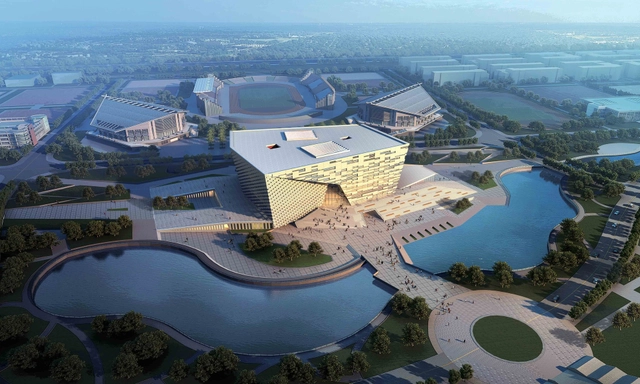
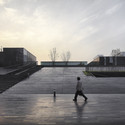
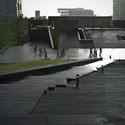
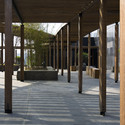
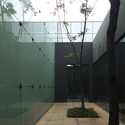
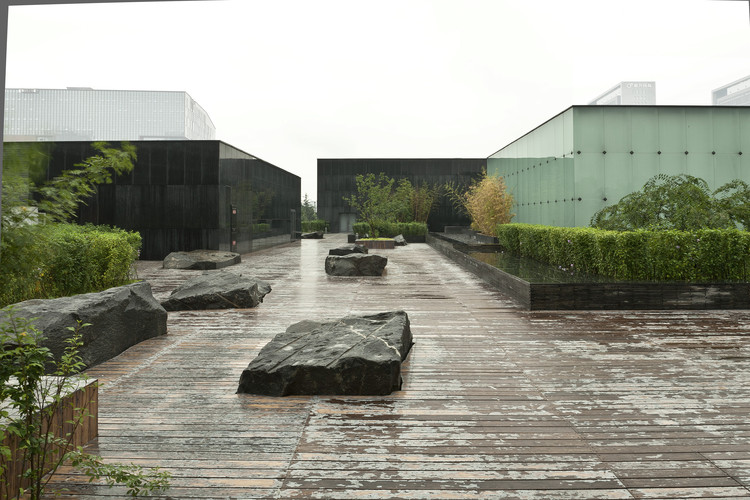
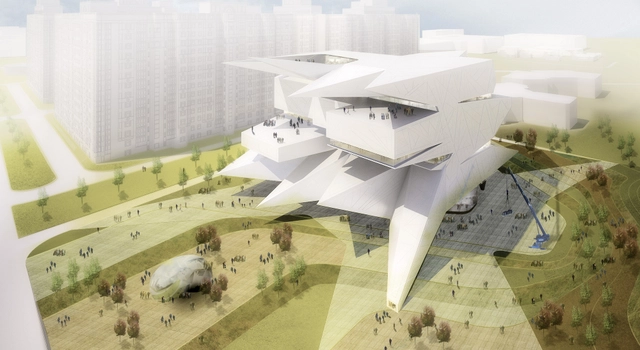
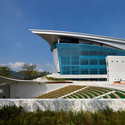
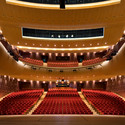
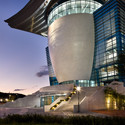
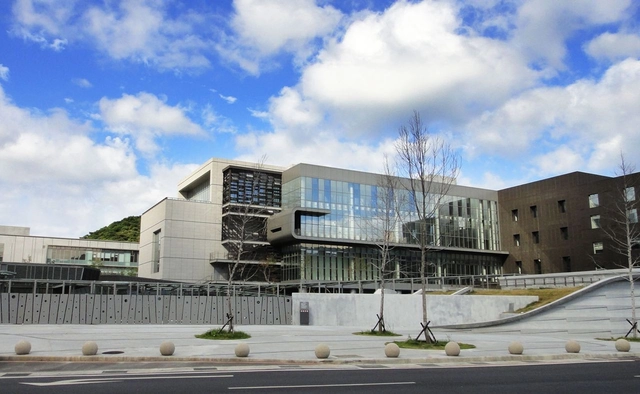
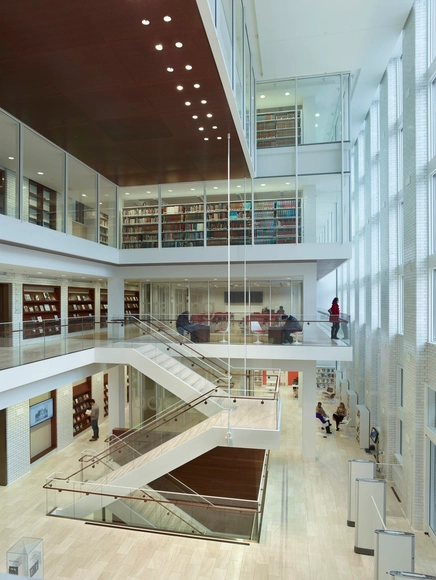
With an area of 48,636m2, the site of the Hebei University Library is located in the center of the new Beicheng Campus. This competition winning proposal by Damian Donze, of the Tongji Architectural Design and Research Institute, is clearly divided. The base of the building is designated for some offices, an archive, a network center, a convention center and an exhibitions center. This way, the West entrance is reserved for the offices and the the network center while the East entrance is reserved for the convention center and the exhibition center. More images and architect's description after the break.
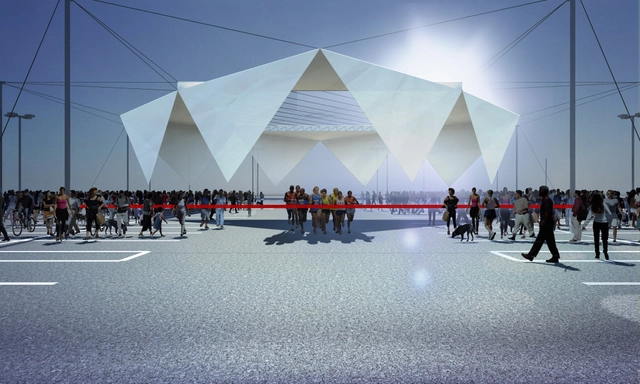
Designed by Ksestudio, their “Stage a lot” Flat Lot competition entry, which received an honorable mention, is a constantly transformative intervention that responds to the call for a temporary structure from the Flint Public Art Project. The project invents a ballet of ropes and pulleys animating four suspended rectangular pieces of white tyvek that in a neutral position hang vertically to form a topless cube. More images and architects’ description after the break.
Designed by Leeser Architecture their design concept for the Polytechnic Education Center takes its cues from the rich history of modern Russian architecture of the early part of the twentieth century. Located in the Lenin Hills section of Moscow, which play an important role in the history of Moscow as a place of radical experimentation, the new institute symbolizes this incredible energy and conflation of future inventions with past achievement as a new symbol of global importance. More images and architects’ description after the break.
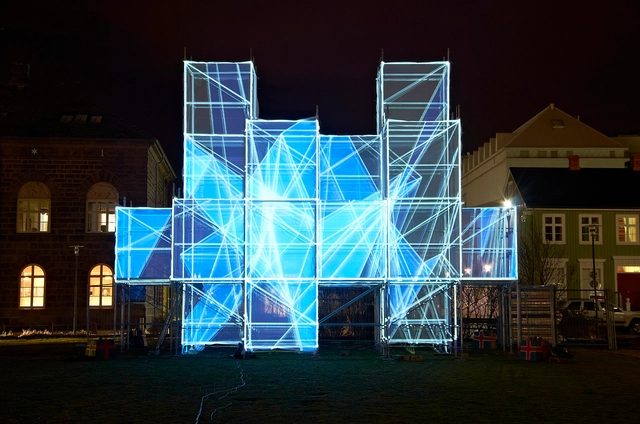
Designed and directed by Iceland based architect Marcos Zotes and his studio UNSTABLE, their Pixel Cloud installation is the winning competition entry for the Reykjavik Winter Lights Festival 2013, organized by Höfuðborgarstofa, Orkusalan and the Iceland Design Center. The installation creates an opportunity for Icelanders to reconsider the use and management of their urban public spaces. With the current financial situation leaving a permanent landscape of obsolete scaffolding structures scattered across the city, this has resulted in urban scars that remind us of the fragility of their current society. This installation takes advantage of this condition by transforming an ordinary scaffolding structure into a fully immersive environment of light and sound in the heart of Reykjavík. More images and architects' description after the break.
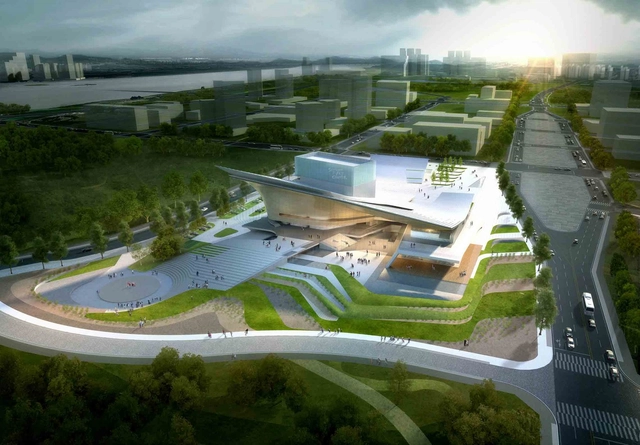
Designed by DMP Partners, their winning proposal for the Sejong Art Center (SAC) is composed of two theaters, a main theater with more than 800 seats, a medium sized theater with 300 seats, a film theater with 250 seats, and an art gallery. Located in the international cultural area between nature-scape and urban-scape, the building combines nature and city through its straight, linear shape. This form is applied in accordance with the city and its curvature shape is in accordance with nature to create a comfortable feeling. More images and architects’ description after the break.
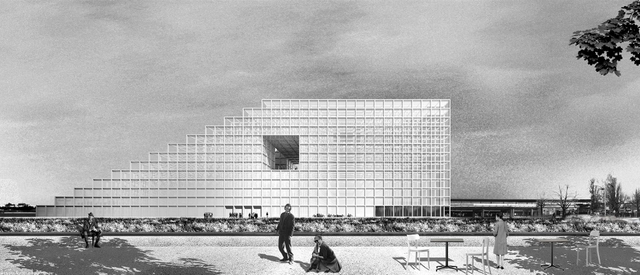
Mediating between iconic metaform and the human scale, this proposal by FAR frohn&rojas is one of the winners of the architectural competition for the new central library of the state of Berlin at the airfield of the former Tempelhof Airport in Berlin. By twisting a three dimensional grid from horizontal to vertical, the three key urban drivers of the site - the runway, the motorway and the former airport building - are resolved. More images and architects' description after the break.
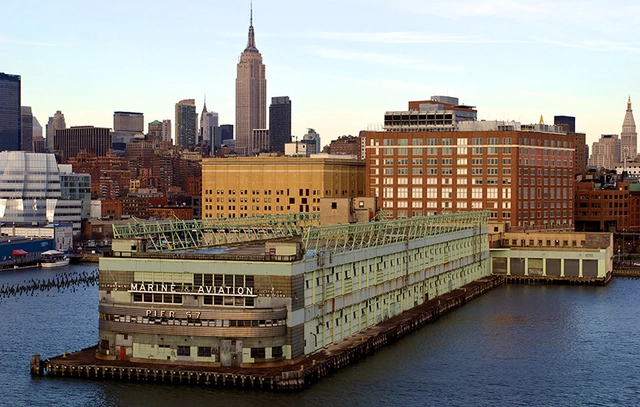
New York's City Council have unanimously backed a proposed plan to restore and redevelop the aging giant that is Pier 57. Built in 1952, the 300,000 square foot pier was hailed by Popular Mechanics as a 'SuperPier' for its vast size and unconventional construction, as most of the pier's weight is supported by 'floating' air-filled concrete cassions. The pier was originally used as a bus depot by the New York City Transit Authority, however it has been lying vacant since 2003. The latest decision brings a concrete end to years of speculation as to what the fate of the pier would be.
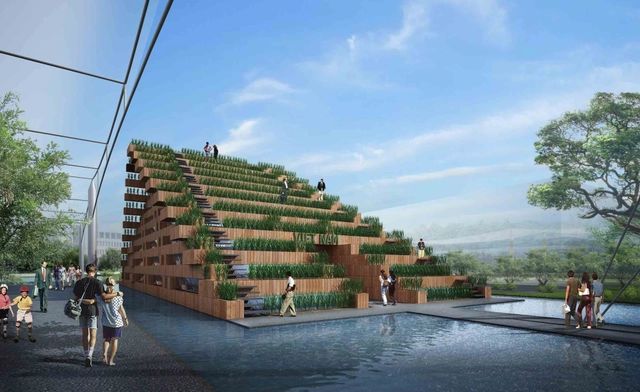
The concept proposal for Vietnam’s Pavilion at Expo 2015 in Milan focuses on mixing settlement and settled agriculture to create the future’s space – the space where settlement and settled agriculture include each other. Titled the Pavilion of dream terraces (field), the building by H&P Architects is created from steel structure frames, which have a large amount of modules – the longest one being 7.5m - that are connected by simple joins or overlapping. More images and architects' description after the break.
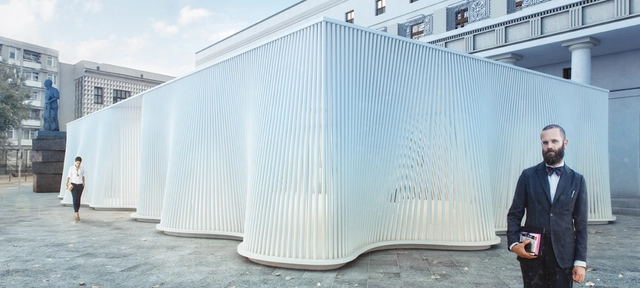
Inspired by the movement of the curtain, an element inherently connected with the theatre, this second prize winning proposal for the Operlab competition focuses on this movement to induce the emotions of the viewers. Designed by Rafal Oleksik and Krzysiek Stepien, it was crucial in the proposed concept of the pavilion to induce such emotions to encourage people to enter the facility, and at the same time, allow them to become a part of the show whether it be exhibitions, screenings, a concert or a discussion. More images and architects’ description after the break.