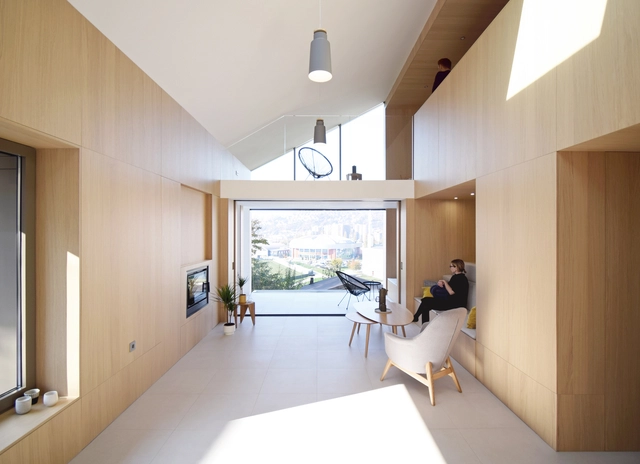
In between. The newly built structure is complex, establishes and forms its own world, equal and self-sufficient. The interior is unexpected, closed and open, it belongs to both the street and the house. A density has been created that allows programs and functions to exist in space and time experiencing various daily changes.
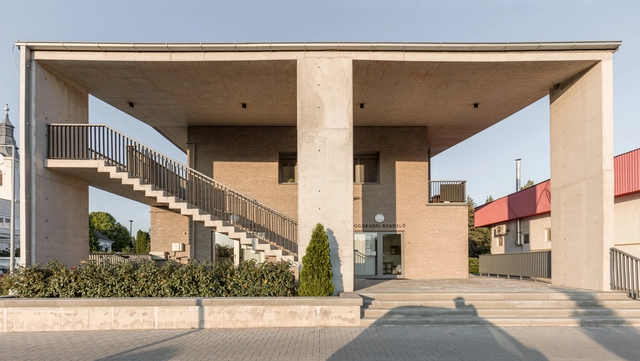
Gyermely Town Center. The project encompasses the revitalization process of an aging and increasingly impoverished Hungarian small town. Far from the bustling metropolitan areas, the agriculture based rural lifestyle is slowly disappearing. Poverty, aging communities due to the migration of young residents and depopulation are common tendencies, yet over the last decades, the community of Gyermely has successfully implemented projects to reverse this process. Long-term and systematic thinking is a prolonged, small budget process, resulting in interim milestones such as the development of a new town center.
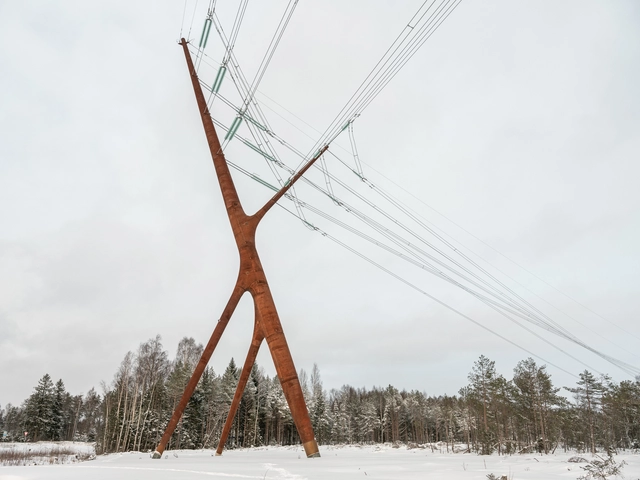
Design pylon Bog Fox The high voltage design pylon Bog Fox is a unique piece of infrastructural architecture. Combining local folklore, architectural design and infrastructural engineering, the Bog Fox has become a landmark for a holistic view on our living environment in Estonia.
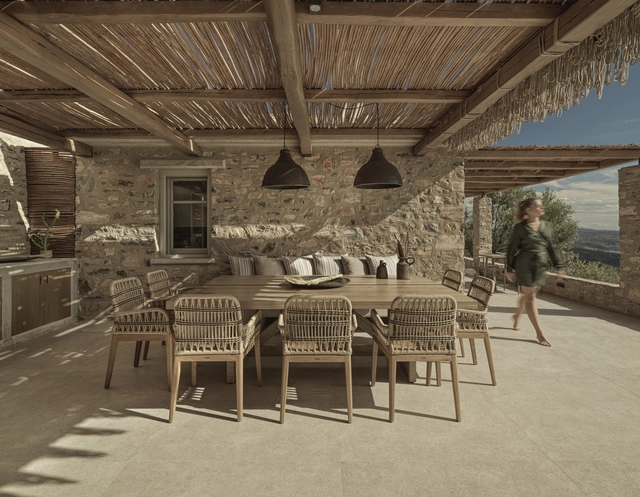
Leaning on the rock of the mountain, adapted to thelandscape and built with natural materials, this residence has an elongated shape, protected from the north and views onto the sea on the south. The project succeeds adapting the building in the environment, use of local materials, exploitation of the view and protection from the weather conditions. Vacation residence in Crete, on Livadia, 1-hour road from Chania.
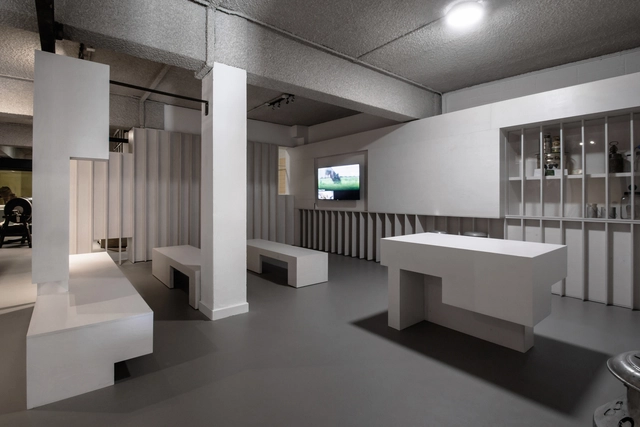
These works consider the collection of artifacts and spaces in the Butter Museum. Reanimating a distinct historic urban field, they heighten the awareness of the socio-cultural roles of butter making in Ireland. The design erodes existing boundaries and alters spatial limits - encouraging new juxtapositions and readings between objects and viewers.
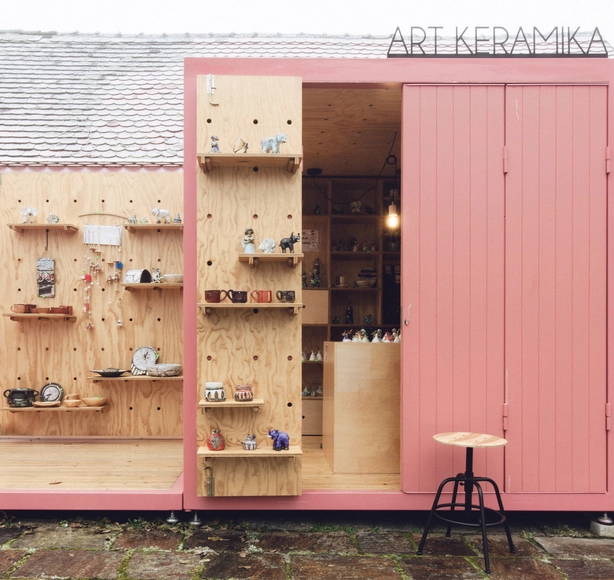
By engaging all senses to define the experience and stories of space, a unique project was being established. The urban solution approach, for the public square and contemporary designed modular kiosks in the Baroque historic city in Varaždin, ought to emphasize and preserve the identity on-site, and at the same time promote sustainability and local craftsman production. The project aims to highlight a new design, for an existing public square in the historical fabric of the city; while formating a functional and inspiring gathering point for tourists and strengthening the educational character. Over the years, this area has undergone a transformation and has become an important craftsman location. In order to emphasize its purpose and attractiveness, the newly designed solution offers a sensitive approach that would nurture and preserve the current spatial identity. And, still offering new possibilities, better presentation space for the local craftsmen, and public space that is flexible and adaptive to various occasions and events.
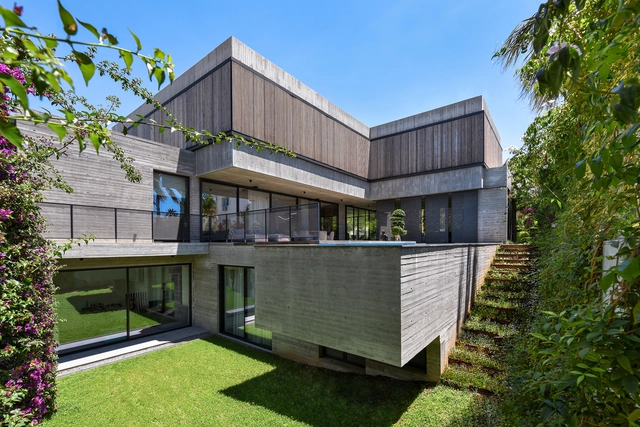
The Concrete House @ Paniotis is a bespoke single family house located in the fairly dense suburban area of Paniotis in Limassol and stands in stark contrast to its adjoining properties. The linear plot afforded a longitudinal placement of the project; perpendicular to the narrower street façade. Although the plot is surrounded from pre-existing properties in close proximity, the project achieves organic fluidity between inside-outside, spatial permeability and the perception of openness. The arrangement of the house in the plot manipulates visual relationships with the adjoining properties and strategically hides and reveals parts.
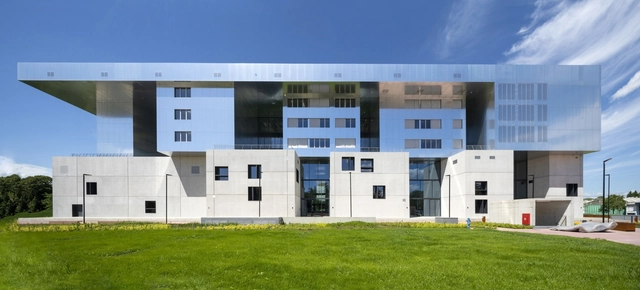
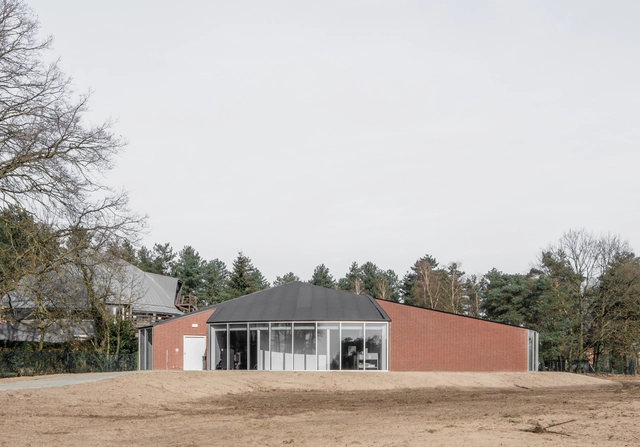
Geometric operation. The task of adding a new pavilion requires to be both attentive to its architectural qualities, and prospective about its potential. The new building is neither an ode nor a critic towards the existing center. It tries, above all, to find rich complementary interrelations with the existing environment and to charge the space in and around it with new possibilities. The designed pavilion acts as a Machikado. This Japanese word refers to a city-corner and is similar to a French Passage. Like a crossroads it concentrates and diffuses at the same time, encouraging equally interaction and isolation. The different dispersed spaces – such as the printmaking studio, where artists can concentrate on their work or the exhibition hall where visitors can wander around the displayed work – cross paths at the center of the new building.
SAAHA’s winning competition design for a Visitor Center at Mt. Fløyen in Bergen, aims to facilitate the use of this popular mountain landscape for children, youth, hikers and tourists. With its undulating movement, the pavilion leads the visitor from the gravel road around the lake to the walkways through the surrounding mountains.
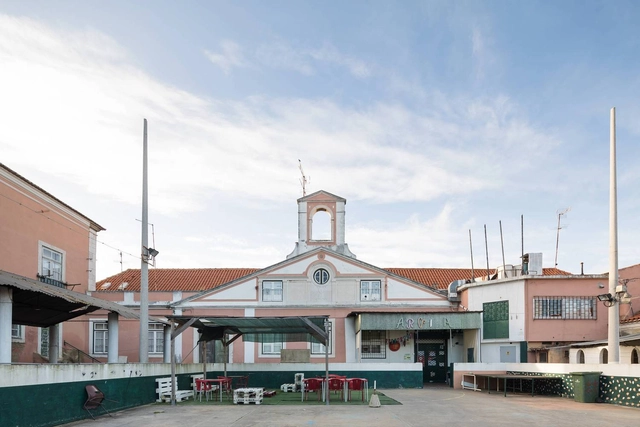
The Marquês de Abrantes Palace, wedged between two railway lines, on Rua de Marvila, is a public building that served since the XX Century as popular housing and, nowadays, serves as headquarters of one of the city's oldest collectivities - Musical Society 3 d'Agosto de 1885. It has been in an expectant territory for several years: while it has the so-called social neighbourhoods to the North, to the South it finds the river and its speculative and gentrifying real estate projects. The project is linked to this dual reality, trying to ensure that through a process of collective questioning and decision-making, we can go against the logic of eviction of the working class allowing, on the contrary, their fixation.
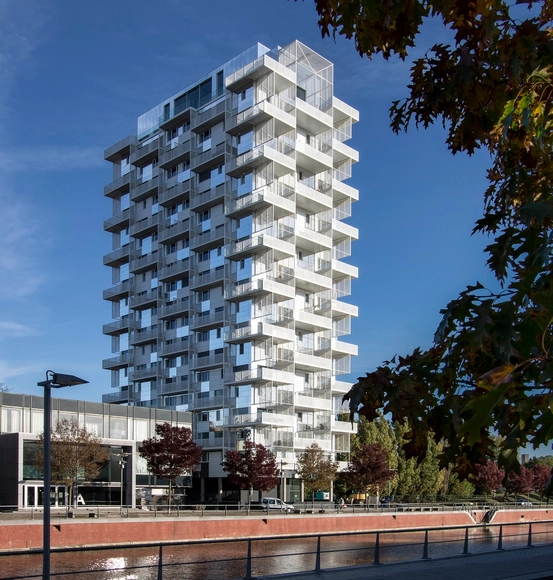
The importance of the vertical development of cities. The vertical development of cities is one of the foundations of future urbanism for the sake of preserving the natural and agricultural territories. The verticality is the result of common sense but the livability of vertical housing remains, as its architecture, to be elaborated in order to give rise to a community of inhabitants. For decades, Philippe Samyn conceived proposals in this direction (see, for example, his essay "The Vertical City" published by the Royal Academy of Belgium in September 2014).
The recovery and transformation of an old industrial building from 1920 into a museum, highlighting its special configuration in three naves and its interior textures, adding new layers that adapt it to the new use. The Oliva Artés industrial building was to be demolished in 2008 in the context of the new construction of the Central Park of Poble Nou, which planned to cut the continuity of the historic Pere IV street to which the building is closely linked. A few days before the entry of the excavators a neighbourhood association dedicated to the industrial heritage of Poble Nou convinced the City Council of the need to preserve the building, which at that time was in a state of structural ruin.
Situated in an ordinary unplanned neighbourhood in Sarajevo, the Half House is a new studio extension and refurbishment of the ground floor of a typical Bosnian ‘family house’. The Half House has been designed for a wheelchair user and his wife by Projekt V Arhitektura. The studio extension is a new typology for the area: it is in between a detached studio house, a family gathering space, and a ‘weekend’ countryside house common to the region.
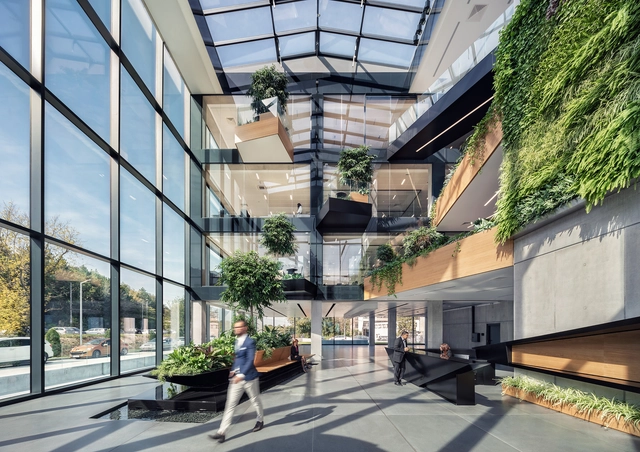
Desizo Monni corporate office building provides a creative working environment for a local fashion brand. It is located in an industrial town in one of the poorest regions in Europe. The key goals of the project were to create a new identity for the brand and to create a better environment for young talents who live abroad and wish to return in their home country.
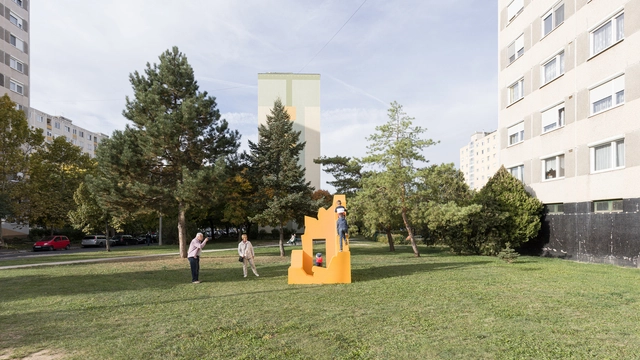
Modernist housing estates are rejected, just as the Haszkovó housing estate in the city of Veszprém, Hungary. Their stories are understood as the stories of failed urban developments, they are grey, sad, and soulless. Can something be soulless and grey which gives home to 20.000 inhabitants? Instead of letting our prejudices drive our view on modernist housing estates, is that possible to reconsider our relationships and think about them as “real cities” and to complete them with creative ideas?
The bus station built in Vilkaviškis – a small town in the Lithuanian province with a population of around 11.000 inhabitants – not only performs the function of the transport infrastructure, but also solves an explicit social mission.
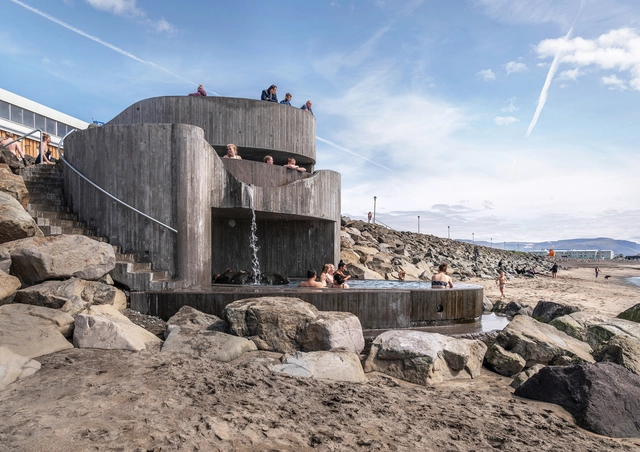
Guðlaug baths rest in the rock barrier of Langisandur Beach, facing the vast North Atlantic Ocean. They are a testament to the positive effect a single architectural intervention can have, as they enable and encourage interaction with the ocean and the elements. Guðlaug is a free entry, democratic, public space, and a community favourite. Guðlaug has also played a role in strengthening the image of the township and attracts scores of visitors from Iceland’s capital, Reykjavík (40 min away) as well as tourists, with a positive effect on the local economy.
Built in a privileged location in the southern part of Pelion, close to an old olive grove with an unparalleled view of the Pagasitic Gulf, Peliva Nature & Suites offers a high quality place to escape, relax and stay. The simple naturalistic design with emphasis on the natural scenery, the rawness, the real but at the same time familiar, timeless and hospitable where nature is in the spotlight, all create an atmosphere to make the guest surrender to the warm harmony of an authentic experience.