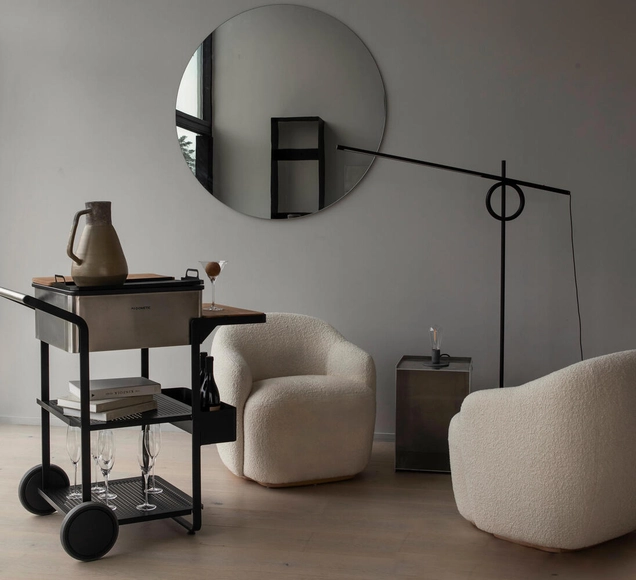
MoBar 50 / Dometic Home. Image Courtesy of Dometic Home
According to a recent survey by spirits industry market analysis firm IWSR, 54% of online buyers of alcohol in the U.S. made their first purchase during the pandemic. Most consumers decided to ‘treat themselves’ to more expensive spirit brands than usual, many opting for the higher shelf bottles in order to finally master the art of home-made cocktails – elaborate, to-be-sipped drinks worthy of the bigger investment. IWSR says that those habits are sticking. Along with them comes the need for an aesthetic plan of attack concerning the display of said pricey bottles: home bar architecture.
Wallpapers can be quite controversial. They can be typical of old-fashioned and antiquated homes, but at the same time, they can also add personality to otherwise dull spaces. One of the best parts of using these elements is that they can be quickly installed, and with relatively low costs. This also means that they aren't very long-lasting, and can therefore be quickly discarded and replaced, making them transient decoration items. As Joanna Banham—a researcher on wallpapers—states, “Wallpaper is often regarded as the Cinderella of the Decorative Arts – the most ephemeral and least precious of the decorations produced for the home. Yet, the history of wallpaper is a long and fascinating subject that dates back to the 16th century and encompasses a huge range of beautiful patterns created both by anonymous hands and by some of the best-known designers of the 19th and 20th centuries.” Today we are seeing another wallpaper resurgence, with numerous options of materials, patterns, and colors, and several examples of architects who have used them creatively in their projects. In this article, we go through the history of wallpapers and some of the current alternatives on the market, by diving into the Architonic catalog.
The threshold is a constructive element of the floor that serves to finish when there is a notable change in material or level. Much more prominent in the past, the piece today has a more discreet presence in architecture.
The thresholds and transition strips are applied directly to the floor and are responsible for making the transition when there is any change in the built space, whether it is in level, in the type of floor, or even when there is a door or passage.
The current architectural production faces several paradigms and one of them is aesthetic. In a scenario of constant uncertainty, buildings with projections, holograms, or completely automatic ones that science fiction has shown so much, seem more and more distant from reality. Nowadays, the search for greater identification with the built space has been amplified instead of idealizing the new for the new. Therefore, looking at the past has presented different perspectives and it is in this scope that perhaps we can imagine a new futuristic aesthetic.
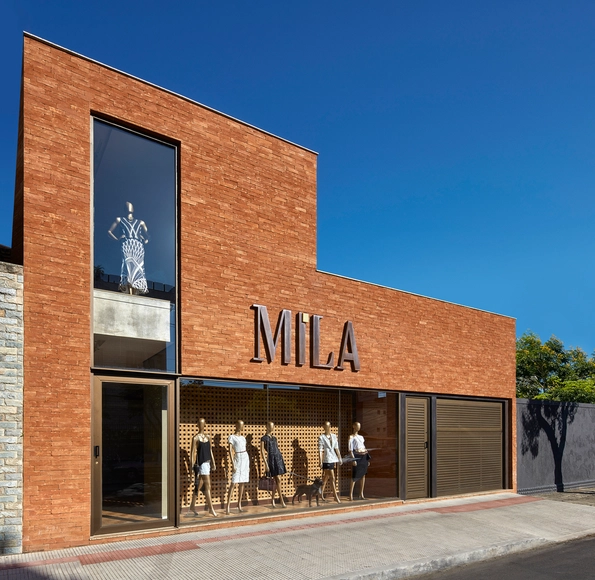
Window displays are the means of communication with the customers, the transition layer between the street and the store. From its emergence in the 2nd century, in the Roman Empire, until today, many changes have taken place until we reach the current windows, which not only display products, but also the identity of brands. Here is what to consider when designing a showcase.
An empty wall is not always a breath of air, at times it can give a cold feeling of missing something. And that is why it presents itself as a space to be occupied to bring more originality and greater character to your space. The question is: how can we intervene in it? Below, we have gathered some ideas from various projects to inspire you.
HeartFelt® Multipanel. Image Courtesy of Hunter Douglas Architectural
Known as the “fifth wall,” a ceiling is the interior overhead surface that covers the upper limit of a room. Unlike decor, wallpaper, furniture and other pieces that define indoor ambiance, it is not usually emphasized as a crucial design component, often resulting in the classic plain white shade that continues to be the norm in many, if not most, interior spaces. Nonetheless, ceilings can serve multiple purposes in any architectural project. For example, they provide comfort, act as protective surfaces for other building systems, conceal structural elements, and add layers of texture, movement and color. They also allow the enclosure or separation of spaces and contribute to sound diffusion, hence reducing noise transfer between rooms.
Most of us use stairways every day, but few times do we stop to contemplate their design or put much thought into their function. With their steps, treads and railing, they are easily one of the most fundamental architectural elements in any home. Apart from providing a safe, simple and easy access from one floor to another, it is through staircases that architects create unique spatial forms and strong visuals. From afar, one can observe people moving up and down repeatedly; from within, the user is treated to new angles and ways to perceive a space. Therefore, good staircases are more than just means of vertical circulation. Through their might and scale, they can become the protagonist of a space – a design focal point that rises to the level of art. In this article, we present their versatile characteristics and material qualities through a selection of inspiring examples, all of which can be found in Architonic's 'Staircases' section.
If, on the one hand, bathrooms have a certain rigidity when we think about the layout and their spatial arrangement, it is in the floor and wall coverings that this logic is inverted. With the wide variety of models and patterns available on the market, ceramic tiles and porcelain tiles are often used to give quality and identity to space. At the same time, the ease of access to ceramic and porcelain tiles, as well as their ease of installation, end up conditioning our choices, making it difficult to think of other finishing possibilities for these areas.
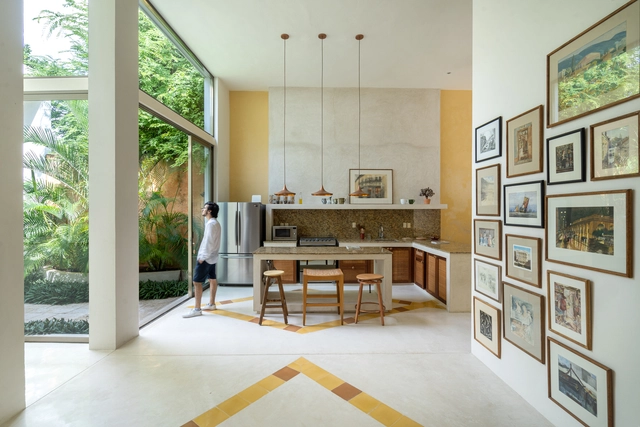
Whether in a compact studio in Hong Kong or in a Michelin-starred restaurant, kitchen design requires special attention in order to make the act of preparing food a pleasant experience; with adequate space for all necessary functions and without the need for useless movements. The theory of the “golden triangle” or “kitchen work triangle” was conceived 100 years ago but remains valid and helpful in the definition of layouts and the organization of functions. Basically, the three main elements of the kitchen should be located at each end of the triangle: the sink, the refrigerator and the stove, with their respective functions in cleaning, storage and cooking. According to its principles, each side of the triangle must be between 1.20 and 2.70 meters long, and the perimeter should not be less than 3.96 meters or more than 8 meters.
Of course, it is not always possible to have the ideal dimensions and proportions to implement this type of kitchen, especially when we take into account the increasingly lean dimensions of contemporary environments. Nevertheless, there are various ways of making everyday operations more efficient even in tight kitchens. Below is a selection of items and products that can increase the space and efficiency of kitchens, without having to add even one square meter to them, straight from the comprehensive Architonic catalog.
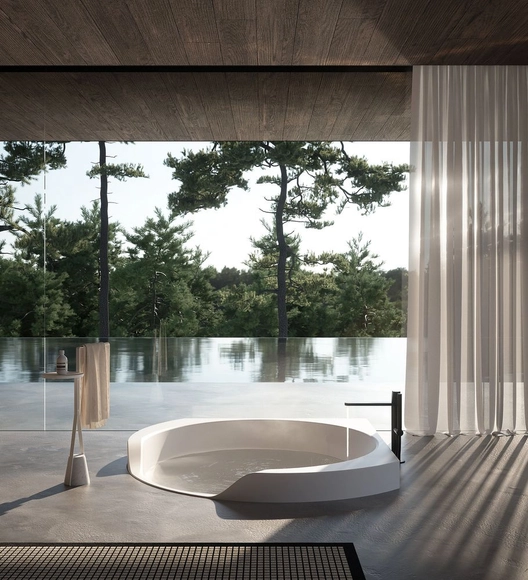
Throughout the years, bathrooms have been viewed as purely functional spaces strictly programmed for hygiene and privacy. Becoming smaller and more practical, the utilitarian, space-saving shower stall has often been considered the norm, pushing the bathtub into obsolescence or as an additional luxury for those with extra space (and money). Recently, however, as lifestyle changes driven by the pandemic have placed wellness as a top priority, the notion of the bathroom as a sanctuary has really taken hold. Contemporary bathrooms have thus been reimagined, shifting towards open spaces of relaxation, comfort and recuperation. And tubs – with their inherent meditative nature – have returned to the spotlight.
Over the years, interior design has evolved according to the needs that arise, but above all, according to the experiences it seeks to evoke in the user. Over the last two years, we have witnessed a radical change and a special interest in this subject because the pandemic forced us to pay specific attention to the configuration of the places we inhabit. This brought about much more holistic designs that seek to address the wellbeing of the user, combining colours, sensory experiences, technology and natural elements that promote health.
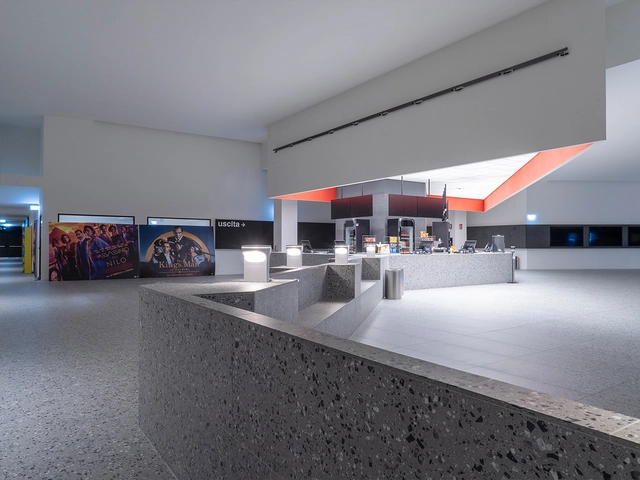
Arcadia Cinema / DW9. Image Courtesy of Iris Ceramica Group
In the context of the pandemic, where several businesses were forced to close temporarily, movie theaters across the world were among the most affected. Fast forward more than two years later, and the lingering effects of COVID-19 are still present, marking a turning point in the traditional cinema experience. But even as attendance is still not close to pre-pandemic levels, certain segments of moviegoers are enjoying the benefits of the giant screen, comfortable seats, massive speaker systems and theater snacks.
Located somewhere between opacity and transparency, translucent surfaces allow rays of light to partially pass through them, creating a "blurred" aspect to what is seen on the other side. This is an effect widely used in art, as in the works of the Icelandic–Danish artist Olafur Eliason, for example, who works with optical illusions through light and colorful and transparent surfaces. But it is also admired by contemporary architects, such as the Japanese office SANAA, or European offices such as Barozzi / Veiga or Lacaton & Vassal, among many others.
In buildings, when using translucent surfaces with materials such as polycarbonate or glass, elements become visually lighter and highlight interiors or even the building's structure, without intruding on inhabitants' privacy. Chairs, lamps, pots: there are several everyday objects that use translucency for aesthetics and lightness. In the bathroom, however, this is not so common. Usually made of porcelain, the traditional pieces used in this space are opaque and at times are not so flexible to allow for a designer's vision.
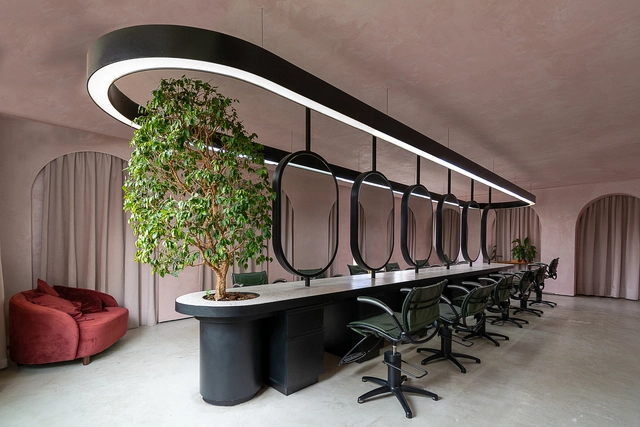
Usually, people look for a beauty salon to leave transformed. In addition to the aesthetic changes, the environment itself can trigger different sensations that change the mood of customers. That being said, some establishments hire architects and interior designers to think of ways to innovate their spaces. Relaxing, having fun, surprising, are just some of the actions that can be passed through a project that thinks about different ways to bring comfort to users.
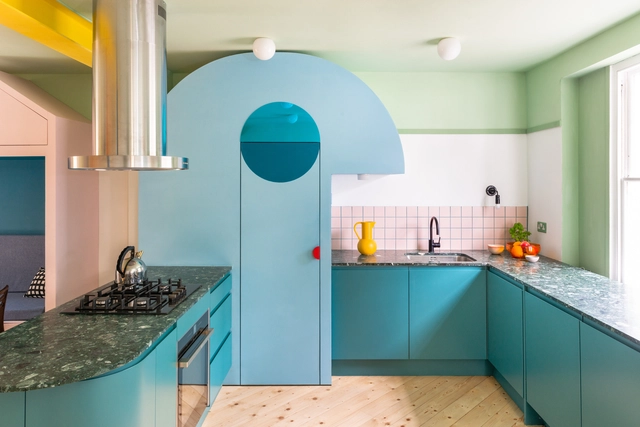
As transitory as trends may be, they always have a way of coming back. We see it all the time in fashion, with clothing pieces we thought were long gone coming back in style and reconquering the market. Interior design is no exception. Although this century has set the ideal on subtle sophistication and simplicity – with white surfaces, clean lines and slick gloss finishes –, bold retro enhancements are reviving in residential and commercial interiors. Whether in the form of vibrant colored walls, floors with intricate geometric patterns or vintage-looking furniture pieces, there seems to be a renewed appreciation for design elements inspired by trends from the second half of the 1900s, particularly from the 50s to the 80s.
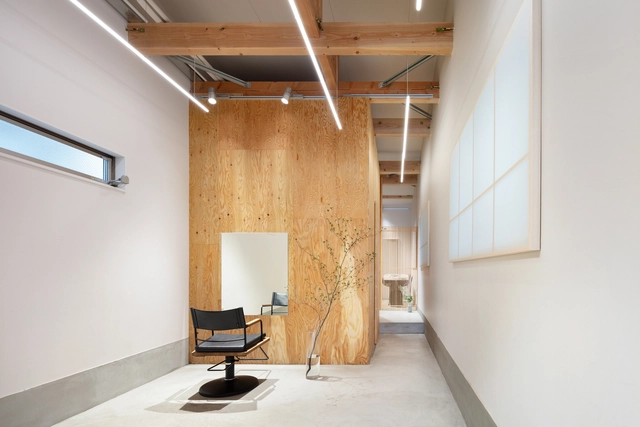
More than ever; today a trip to a hair or beauty salon has become a much-needed escape time. It promises an ultimately uplifting and relaxing experience with an aesthetically pleasing result. However, this affair, like many others, depends on a catered physical setting; a space that’s efficient design can make or break one’s leisurely time. Many spatial considerations have to be taken while setting up a successful and functional beauty shop, and there are no better examples to consider than the quaint Japanese beauty salons.
Wooden floors bring warmth, personality and style to any interior space, whether old or new. Rustic and elegant, wood also has excellent thermal properties, a pleasant temperature to the touch, and can even improve the acoustics of a space by absorbing sound waves. They are also highly durable and resistant to daily use. It is therefore no surprise that they are one of the favorite and most coveted materials for residential interiors. Wooden flooring is also very visually appealing, with a huge amount of variations possible in its design. Pieces can vary greatly depending on which part of the trunk they come from, even if they are from the same manufacturer and tree species. Colors and designs also vary according to different tree species, from light yellows to dark browns, with infinite possibilities. In addition, it is possible to create various types of patterns when laying the floor, according to the dimensions of the pieces used and the desired effect for the space. See below a selection of wooden floors in Architonic catalog.











.jpg?1649785401&format=webp&width=640&height=580)
.jpg?1654265144&format=webp&width=640&height=580)