Earlier in the week, we shared a video ofCook+Fox’s Bank of America Tower at One Bryant Park. Recently, we’ve heard some talk of a new skyscraper that may be making an appearance in the skyline. Situated on the site of the former Drake Hotel at the corner of 57th Street and Park Avenue, the project is the work of California developer CIM, Harry Macklowe and Rafael Viñoly [although it is not designed by RVA]. Macklowe demolished the old hotel and the zoning allows new development to surpass a soaring 1,000 feet! Although all is speculative, Curbed.com reported that the tower may reach 1,420 feet! At that height, the tower will become the second tallest in the city – passing the Empire State and the Bank of America building – and, get this, it will even beat the height of One World Trade [if you don’t count the 400 ft antenna]! Remember all the controversy surrounding Nouvel’s Torre Verre for Midtown? We wonder what this project will stir up with its bland aesthetics and its crazy height. Just to give you an idea of the project, we found these images on Curbed.com and as the site reports, “WNY user STR did some modeling of the Vinoly structure, and another commenter credits the drawings as ‘not official renderings, just rough sketches based on descriptions from some people who have been privy to the design process.’ ” What do you think of the plans for the new Drake Hotel site?
The Gowanus Canal is one of America’s most polluted waterways, and its location in the New York Harbor made it one of the many places that were effected by flooding as a result of Hurricane Irene. If that isn’t enough to think about, last year the EPA declared the Gowanus Canal as a Superfund site, “As a result of years of discharges, storm water runoff, sewer outflows and industrial pollutants, the Gowanus Canal has become one of the nation’s most extensively contaminated water bodies. Contaminants include PCBs, coal tar wastes, heavy metals and volatile organics. The contamination poses a threat to the nearby residents who use the canal for fishing and recreation.”
Rising Currents, an exhibit that was featured at the MoMA just last year, was a cohesive showcase of five projects tackling the lingering truth that within a few years, the waterfront of the New York harbor will drastically change. We highlighted Zone 0 earlier this week, comprised of ARO and dlandstudio, they specifically took a look at the lower Manhattan landscape, proposing to develop a new soft and hard infrastructure solution paved with a mesh of cast concrete and engineered soil and salt tolerant plants.
Zone 4, or Oyster-Tecture by Kate Orff, dealt directly with the highly polluted Gowanus Canal. We shared with you Orff’s TEDTalk on Oyster-Tecture back in Februrary, and feel like it is a subject worth revisiting. Eastern oysters being her focus, she shares how the oyster can improve water quality as a natural bio filter. Blending urbanism and ecology she proposes an oyster reef for the Gowanus Canal and Governors Island, an accessible idea that can be implemented immediately. A further description about Zone 4 Oyster-Tecture following the break.
In the wake of Hurricane Irene it only seemed appropriate to take a second look at Rising Current, an exhibit that was featured at the MoMA just last year. To give you a refresher, the exhibit was a cohesive showcase of five projects tackling the lingering truth that within a few years, the waterfront of the New York harbor will drastically change.
Team Zero, comprised of ARO and dlandstudio, specifically took a look at the lower Manhattan landscape, proposing to develop a new soft and hard infrastructure solution paved with a mesh of cast concrete and engineered soil and salt tolerant plants. This would create greenways that act as absorptive sponges for rainwater. The porous green streets address daily tidal flows and storm surges with 3 interrelated high performance systems (network of parks, wetlands and tidal salt marshes). These systems stop sewage overflow, block higher sea levels and mitigate storm surge.
Rising Current provided an emphasis on how to re-think the city, relevant before, and even more pressing now after the flooding from the hurricane. Let’s hope that the ideas for solutions that were generated from the exhibit can now be considered for implementation. More about Rising Currents and Team Zero’s solution following the break.
As part of an upcoming exhibition, they are developing a New York Archive of Sacred Spaces in Profane Buildings and they need your help. This is an open call for contributions that explain either a story or the memory of a visit, a sketch of a known space, a photograph of a street sign, a location in a map, anything that might help us construct the most comprehensive guide to the sacred unknown of New York. To participate, you are encouraged to submit any material at their website.
More information on the exhibition after the break.
When the iconic Apple glass cube on Fifth Avenue was shroud in barriers in preparation for renovation in June, the future of the flagship Apple store was unclear. It was only revealed that Apple would be removing the glass cube and working on drainage, pavers, and bollards on the plaza, but just what changes were to be made to the cube itself remained elusive.
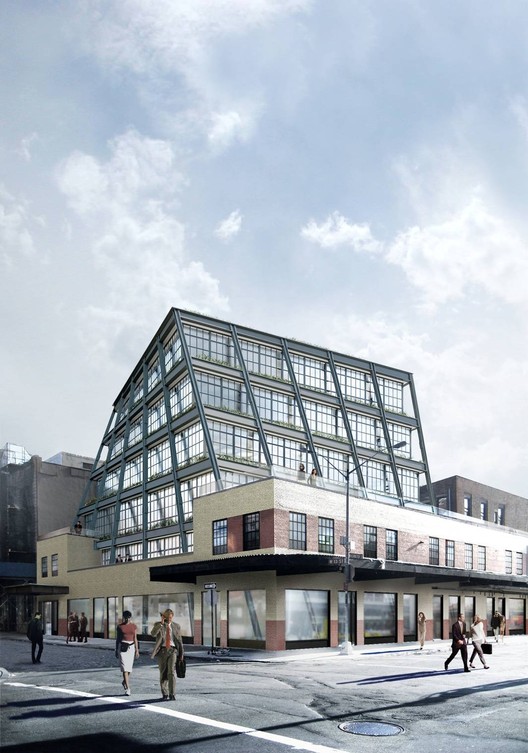
After patiently evolving the design of 837 Washington Street, the Meatpacking District’s newest addition, New York-based Morris Adjmi Architects are happy to announce the project’s recent approval from the Landmarks Preservation Commission. The new office and retail building, which will rise from a 1930s warehouse, will be Adjmi’s fourth building in the Meatpacking District. The project has been struggling to gain approval, primarily due to its height, as the building was originally conceived to stand 100 feet tall; however, the most recent design scheme shows the building measuring just below 80 feet, allowing it to blend more graciously with its surroundings.
The Internet is now the library of the past. Where the public library has historically served as the primary source of information gathering and dissemination, we now look to this new virtual, infinitely large library that can be accessed anywhere at any time as the Library of the present.
As a result, the primary roles of today’s physical libraries have shifted. Libraries of the past focused primarily on individualized information consumption. Communal aspects of interaction and information dissemination now represent the core mission of the library when information is more easily accessible. The silent grand beaux-arts reading rooms of New York or Boston have of the past been transformed into flexible communal “living rooms” in Seattle.
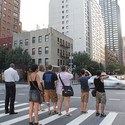
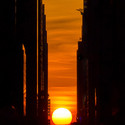
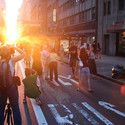
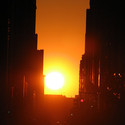
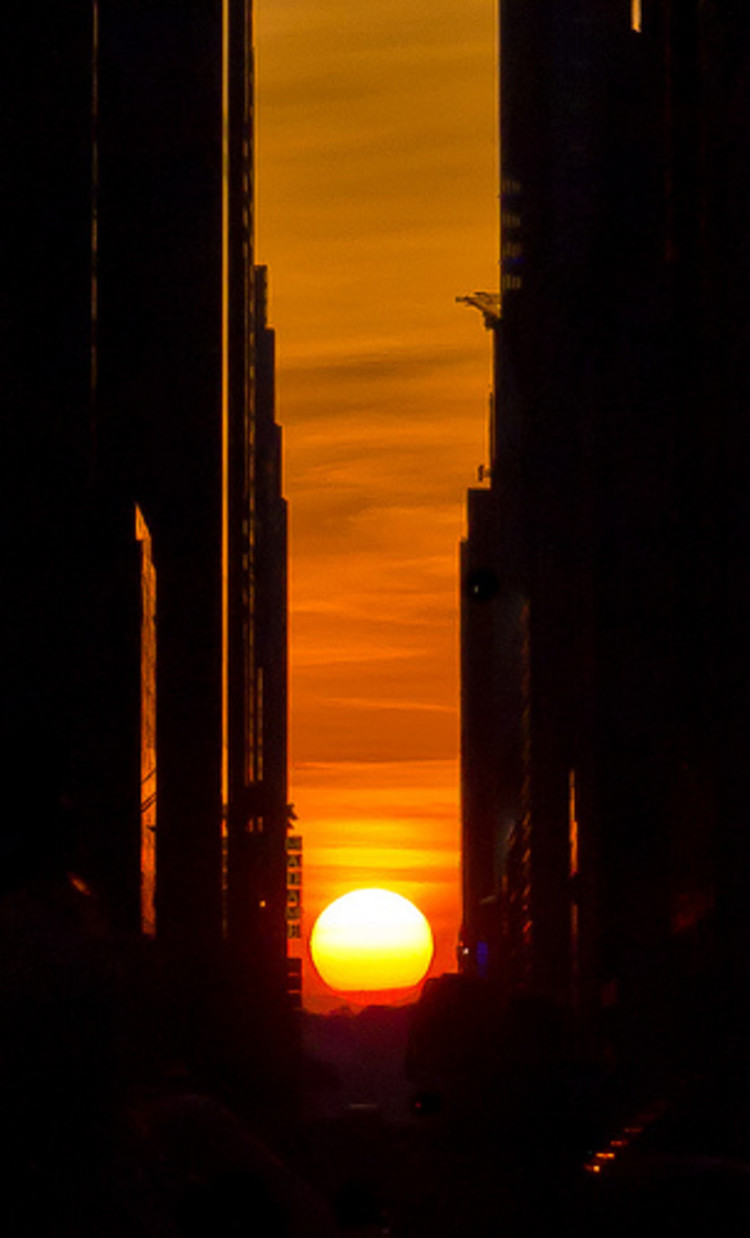
Manhattanhenge, is the term used to describe a biannual occurrence in New York City when the sun aligns with the east-west streets of Manhattan’s main grid. Adopted in 1811 the famous street grid of Manhattan, the Commissioners’ Plan, was the original design plan for the streets in which the grid plan is offset at 29.0 degrees from true east-west. Twice a year photographers gather to witness this urban solar phenomenon, when the sun sets perfectly between the skyscraper corridors and illuminates the north-south facades of the streets. Tripods and pedestrians filled the crosswalks this past Wednesday to catch a glimpse of this moment.
One of the New York City’s most forgettable buildings has been transformed into a model of modern technology. The Port Authority Bus Terminal (PABT), located in midtown Manhattan between 40th and 42nd street, now boasts the world’s largest transparent media façade completed by GKD Metal Fabrics which effectively covers the building’s outdated steel façade. More images and project description after the break.
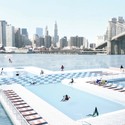
A 30-day Kickstarter campaign to raise funds for the continued development of + Pool is underway. From the creative minds at Family and PlayLab, + Pool is a collaboration to design a floating riverwater pool for everyone in the rivers of New York City. Beginning the next phase of the project, material testing and design, the online fundraising campaign hopefully will raise the initial $25,000 needed to begin physically testing the filtration membranes providing results to determine the best filtration membranes and methods to provide clean and safe riverwater for the public to swim in. A preliminary engineering feasibility report was initially conducted by Arup New York, which assessed the water quality, filtration, structural, mechanical and energy systems of + Pool.
Family and PlayLab launched a Kickstarter online fundraising campaign this month with the ultimate goal of generating enough support to prototype the filtration system by building a full-scale working mockup of the one section of + Pool. Research, design, testing and development will continue through the year in conjunction with permitting, approvals and building partnerships with community, municipal, commercial and environmental organizations.
Donation levels for the Kickstarter campaign range from $1 to $10,000 with the hope that everyone interested in cleaner public waterways can get involved. Donors can choose from a variety of incentives and gear up for a day at the pool. For more information about the project and the campaign or to donate click here. Or write to info@pluspool.org.
Follow the break for more details about this project and the history of floating pools in New York City, which date back to the early 19th century.
This project comes from architectural and urban planning firm, solus4 who has devised a set of principles that guided the design of the Sustainable Vertical Neighborhood. This “neighborhood” takes its form in an iconic 950 foot tall residential tower in New York City. Applying these principles to a vertical neighborhood requires the full engagement of the design team, the building team, the financing team and the owners.
West 57th, BIG’s design of a New York apartment building for client Durst Fetner Residential, takes shape in model form in this video. On display at the Louisiana Museum of Modern Art, the model is part of Living: Frontiers of Architecture III-IV exhibition. The exhibition which opened the first of this month and will run through October 2nd ‘is full of impressions and insights into the multiple ways we live in the world today’.
The young Parisian firm Planda Architecture has shared with ArchDaily their recent competition entry for the Museum of Comic and Cartoon Art in Manhattan. Follow after the break for additional images of this project in addition to a description from the architects.
Storefront for Art and Architecture, the New Museum, and New York City’s Department of Transportation (NYCDOT), are pleased to announce that a team of emerging New York City-based designers from the studios Family and PlayLab have been selected as the winners of Storefront’s StreetFest international competition to re-envision temporary outdoor structures. The StreetFest competition asked for designs that envisioned street tents not only as shelters but also as active elements within the collective construction and understanding of the city.
More on the results of this competition after the break.
Rem Koolhaas will provide the Keynote Address for the upcoming Festival of Ideas for a New City on Wednesday May 4th at 7:00pm held at the Rosenthal Pavilion at the Kimmel Center. Tickets are currently available for purchase.