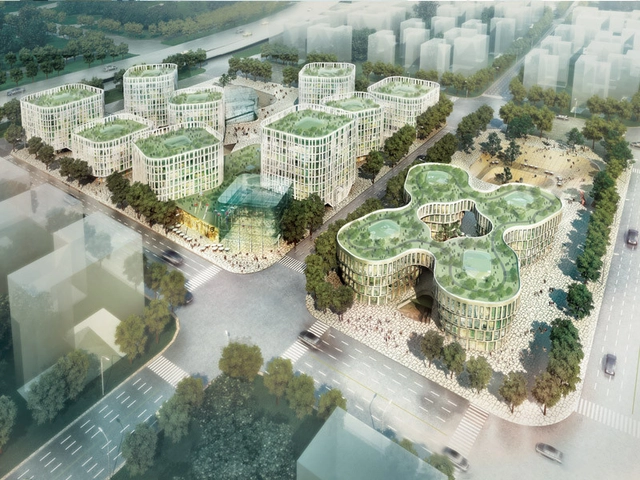
Upon recently winning the competition, MVRDV's design for the Hongqiao Business District recently started construction. The plan comprises ten office towers, an underground shopping center, cultural program, parking and a sunken plaza which will bring a more intimate form of urban life into an area currently dominated by large boulevards and urban expressway’s. Located near the fourth busiest airport in all of mainland China, the 4.5ha site is divided into a small northern plot of 8,409 m2 and a larger southern plot. More images and architects' description after the break.
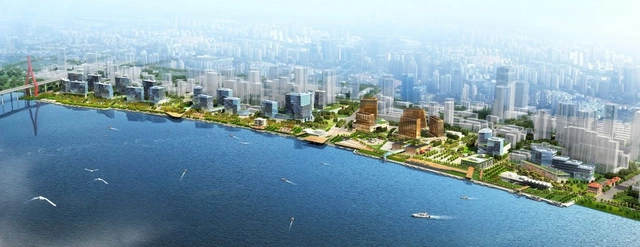
Huangpu River Banks Development just selected INBO and NITA's proposal as the winning design for the master plan for the sustainable large scale Xin Hua Pudong waterfront development in the very heart of Shanghai. Located on the Huangpu River, their low-cardon, 45ha development entails a marina and a green riverside park with a mixed urban program as the green fingers of the park penetrate and interact with the surrounding urban area. More images and architects' description after the break.
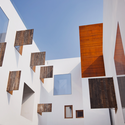
Synthesis Design + Architecture Inc. and Shenzhen General Institute of Architectural Design and Research Co. Ltd have been awarded first place in the invited international design competition for the Shanghai Wuzhou International Plaza. Their scheme, entitled “Urban Canyon”, embodies the energy and vibrancy of the cities distinct urban environment. Inspired by traditional Chinese concepts of Yin and Yang, the project is organized as two nested rock-like volumes which have been broken apart to reveal a flowing canyon condition which connects the project to the urban fabric of the city. More images and architects’ description after the break.
In an article published by The Wall Street Journal called For Creative Cities, the Sky Has Its Limit, Richard Florida discusses the development of urban environments and their relative successes. As human migrations are trending towards big cities, the design and appropriation of space within these cities is increasingly important. Florida cites that trends indicate that by 2050 cities will make up 70% of the global population. With so many people, elevate density within cities will be unavoidable, but what Florida emphasizes is that it isn’t just density that makes a vibrant and thriving city. Citing Shanghai and New York City as examples of dense urban environments, Florida explains the differences in their relative architectural and urban developments and the prosperity that follows. The fundamental difference? The prevalence of mixed-use neighborhoods in New York City that overpower the innovation of strictly financial districts of either New York or Shanghai.