
For some time now, it has become common to wonder where the things we consume come from. We check labels, seek out local producers, and investigate supply chains in an attempt to understand the impact of our habits, whether on our own health or on the planet.
In the field of architecture, however, this question remains relatively marginal. We often know who designed a building, its finishes, the manufacturer of its frames, the brand of its wall coverings, and even its energy performance, but we almost never ask where the tons of material that made its existence possible actually came from.
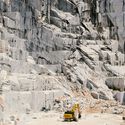

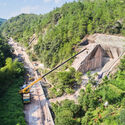
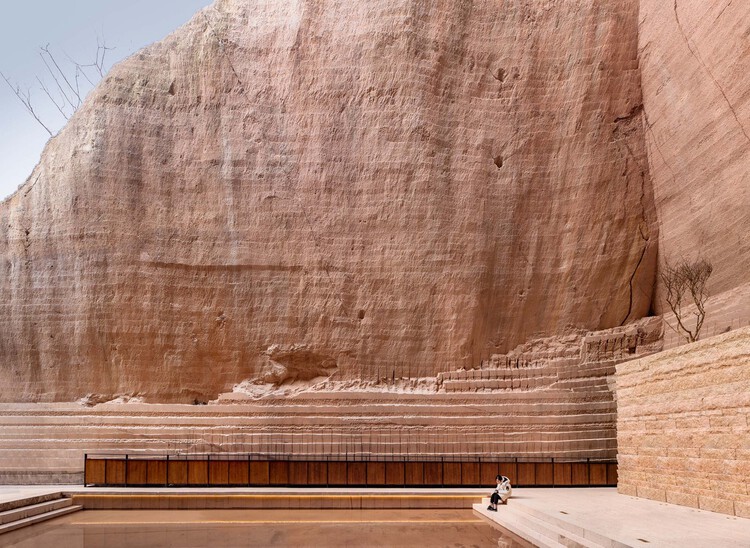
Before becoming concrete, brick, steel, or processed wood, all of these materials share a common origin: they were extracted from the Earth. Construction, therefore, always begins underground, long before the construction site, and perhaps no material reveals this condition as directly as stone. Present in the foundations of architecture since its beginnings, it has accompanied the history of human construction from the earliest civilizations to the aggregates that make up contemporary concrete. This apparent naturalness tends to obscure the complexity of its extraction.
Temporary Quarries, Permanent Scars
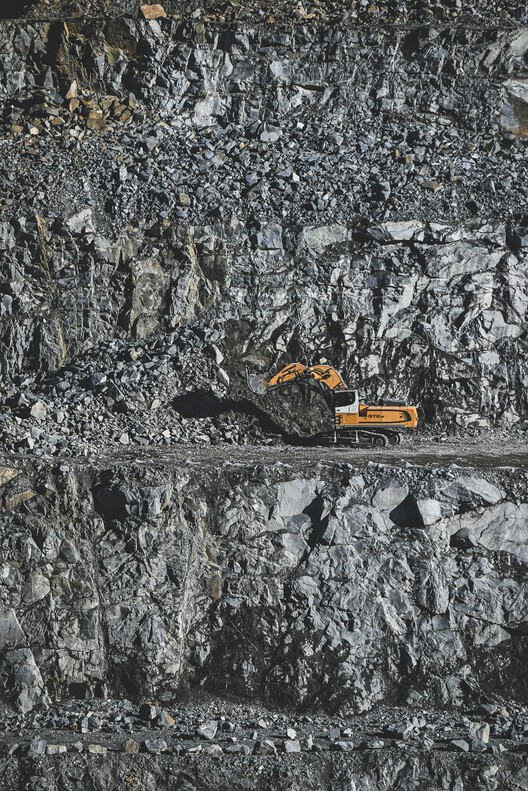
The extractive industry holds a central position in the global economy. Active in 81 countries and responsible for about a quarter of global GDP, it employs approximately 3.7 million workers. In Latin America, this relationship takes on a particular dimension. Brazil, Chile, Peru, and Mexico are among the leading producers of mineral resources, and the expansion of the construction industry has transformed mining into one of the silent foundations of regional economic growth.
This economic importance is directly linked to the fact that much of the built environment depends on materials extracted from the ground. Granite, marble, sand, and limestone constitute the physical foundation of contemporary cities. Granite, often associated with countertops, floors, and facades, is the most visible face of a much broader mineral extraction chain. Concrete itself—the material that defined architectural modernity—depends on clinker produced from limestone subjected to extreme temperatures, a process responsible for about 7% of global carbon emissions.
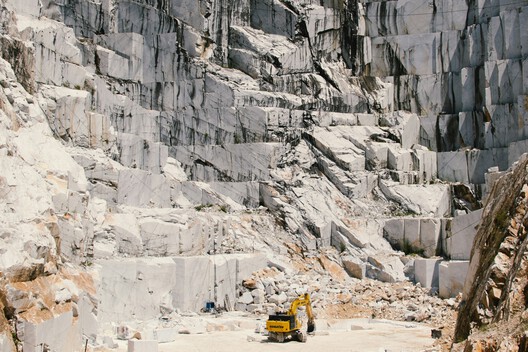
Yet the cost of this material goes far beyond carbon. Without a management plan and environmental mitigation strategies, activities such as clearing vegetation, blasting, and creating open pits can permanently alter hydrological systems, fragment habitats, and eliminate ecosystems established over thousands of years. At the same time, the expansion of mining areas reorganizes local economies, puts pressure on water resources, and, in many cases, displaces entire communities. In various parts of the world, opaque supply chains have also been linked to territorial conflicts, precarious working conditions, and human rights violations, showing that the impacts of extraction extend far beyond environmental boundaries.
Brazilian cases bring these conflicts into sharp relief. In Minas Gerais, allegations of granite quarrying in Permanent Preservation Areas within the Sete Salões State Park expose the risks of mining in sensitive ecosystems and the lack of oversight. In the south of the country, former quarries within what is now the Itapuã State Park left marks that still require restoration decades later. In other words, when extraction ceases to be economically viable, the voids, rocky cliffs, and flooded pits still remain.
This is a condition close to what anthropologist Tim Ingold describes as a rupture in the correspondence between humans and the environment. Instead of understanding the Earth as a living system to be inhabited and with which to establish reciprocity, the extractive logic reduces it to a stockpile of resources available for exploitation. Territory is no longer understood as an ecosystem, but rather as raw material.
Tracing the Material
If stone extraction can alter ecosystems and landscapes, then the choice of a material ceases to be a purely aesthetic or technical decision. Specifying natural stone means, to some extent, becoming co-responsible for the extraction, processing, and transportation chains that made its presence possible. A granite countertop can carry very different histories: from operations committed to environmental restoration and responsible practices to contexts marked by environmental degradation and labor conditions akin to modern slavery.
This ethical dimension makes tracing the origin of materials all the more urgent. In Reciprocal Landscapes: Stories of Material Movements, Jane Hutton proposes a shift in perspective, arguing that materials are not abstract entities, but displaced landscapes. A granite slab is, ultimately, an absent mountain; a marble slab represents a transformed territory, consumed energy, and embodied labor. In other words, what we touch is only the visible part of a much larger geography.

However, this tracking task is far from simple. Unlike the food, pharmaceutical, and automotive sectors, where traceability is well established, the construction industry remains characterized by fragmented and opaque supply chains. The same stone can pass through various agents, processes, and intermediaries before reaching the construction site, rendering its extraction and processing conditions practically invisible.
Research conducted by Asselya Katenbayeva at Loughborough University identified this very fragmentation as one of the main obstacles to implementing tracking systems in the construction industry. The lack of regulation and poor integration among suppliers hinder information sharing and the creation of transparent supply chains. This discussion becomes particularly relevant in cases such as sandstone extraction in Rajasthan, India, where international organizations have been working to combat child labor and precarious production conditions. Lack of transparency, therefore, prevents not only the measurement of environmental damage but also the verification of fundamental issues related to human rights and social and environmental responsibility.
There Is "Life" After Extraction: A New Ethic for Materials
In response to the complexity of this scenario, new tools are being developed to make materials less "anonymous." So-called material passports, for instance, propose that buildings be accompanied by a dataset detailing their composition, provenance, environmental impacts, disassembly potential, and future reuse possibilities. More than a technical inventory, these systems transform buildings into material banks and seek to preserve the memory of matter over time.
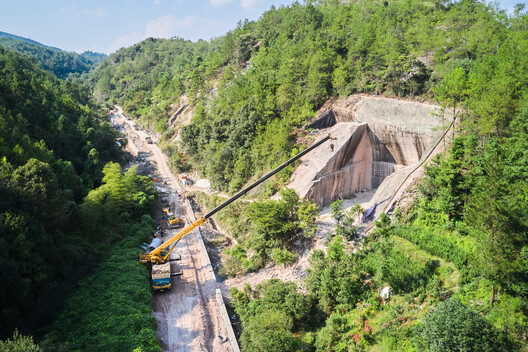
This quest for greater transparency is also reflected in specific initiatives aimed at the natural stone industry. Developed through the ANSI standardization process, the Natural Stone Sustainability Standard proposes a comprehensive approach to assessing environmental, ecological, and extraction/processing aspects of stone. The system considers criteria such as energy and water consumption, waste management, social responsibility, site reclamation, and even the planning of future use for quarries after operations cease. More than just a certification, the standard seeks to establish parameters capable of quantifying practices that, in many cases, were already being adopted by certain quarries, while also stimulating new processes of innovation and continuous improvement in the supply chain.
However, knowing the impacts does not necessarily mean transforming them. According to international projections, global demand for natural stone is expected to nearly double by 2050, indicating that gains in traceability and certifications alone will be insufficient. As Kate Raworth argues in Doughnut Economics, the contemporary challenge lies in abandoning linear models of extraction, consumption, and disposal in favor of circular systems. In architecture, this implies designing buildings from the outset with their disassembly, reuse, and reintegration into new production cycles in mind.
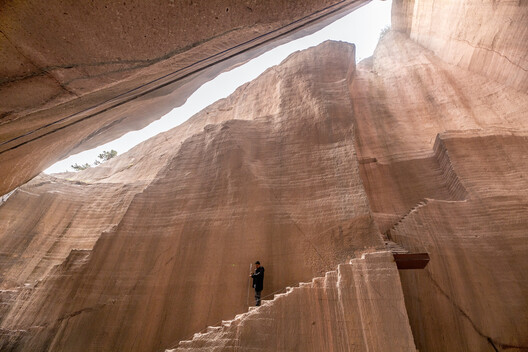
In this context, the discussion is not limited to the materials themselves but also extends to the landscapes from which they are removed. If extraction remains an inevitable part of constructing the built environment, it becomes equally important to reflect on the fate of the territories transformed by it. Although irreversible, the degradation caused by mining can be partially reconfigured through environmental restoration processes capable of transforming former quarry sites into parks, nature reserves, or public spaces.
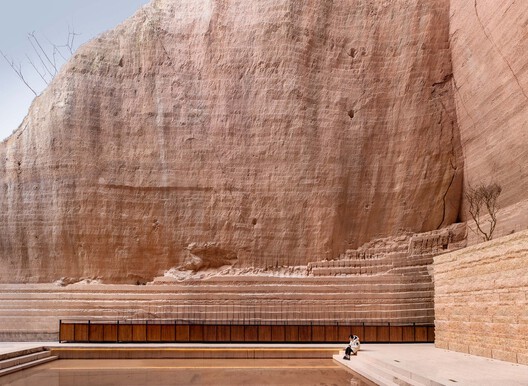
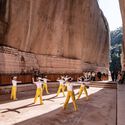
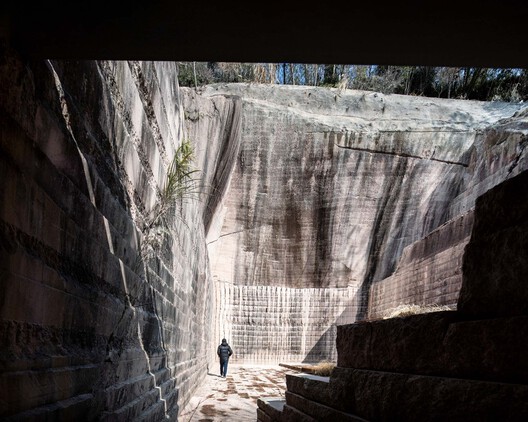
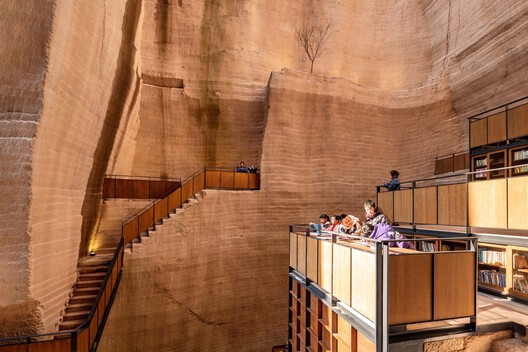
Among the most emblematic examples is the Braga Municipal Stadium in Portugal, designed by Eduardo Souto de Moura, which was built into a former granite quarry. Rather than building on top of the landscape, the architect works with the landscape that remained. Carved into the rock, the stadium transforms the void left by extraction into a constitutive part of the architecture, establishing a relationship that is simultaneously geological and spatial. A similar strategy was used in the project for quarries No. 9 and No. 10 in China, which now serve as performance and gathering spaces.
Jane Hutton writes that materials do not disappear when they are incorporated into buildings; they simply change places. Perhaps this is precisely the central issue raised by the contemporary environmental crisis. Architecture has always concerned itself with what it builds, but rarely with what it removes. Before becoming a wall, column, or countertop, every element was once a landscape. And on a planet of finite resources, understanding the origin of what we touch may be the first step toward rebuilding our relationship with matter.
This article is part of the ArchDaily Topics: Interspecies Architecture: The Life of Materials, Ecological Alliances, and the Action of Nature. Every month we explore a topic in-depth through articles, interviews, news, and architecture projects. We invite you to learn more about our ArchDaily Topics. And, as always, at ArchDaily we welcome the contributions of our readers; if you want to submit an article or project, please contact us.
This article was written by Camilla Ghisleni. The translation is powered by AI.


