1. ArchDaily
  2. 30 St. Mary Axe

30 St. Mary Axe: The Latest Architecture and News

London Architecture City Guide: 20 Modern and Contemporary Attractions to Explore in UK’s Cultural and Financial Powerhouse

Subscriber Access | 

London’s architectural history is a rich tapestry that weaves together styles of various periods and influences. In the post-war era, the city experienced a surge in modern architecture, becoming a canvas for experimentation. New stylistic movements saw their expression crystalized through buildings such as Richard RogersLloyd’s Building, one of the most representative examples of High-Tech architecture, or the Barbican Estate, a large-scale housing estate that became the iconic structure for Brutalist architecture.

London’s contemporary architectural landscape continues to evolve, in part through the works of internationally-recognized architects such as Norman Foster, Zaha Hadid, and Thomas Heatherwick. This varied blend of styles, and ways of expression reflects the city’s ability to embrace architectural movements of global significance. As a center for innovation, London continues to attract established and emerging architects who shape its skyline and contribute to its international architectural discourse, with each new building offering a glimpse into the ever-changing nature of London’s urban fabric.

London Architecture City Guide: 20 Modern and Contemporary Attractions to Explore in UK’s Cultural and Financial Powerhouse - Image 1 of 4London Architecture City Guide: 20 Modern and Contemporary Attractions to Explore in UK’s Cultural and Financial Powerhouse - Image 2 of 4London Architecture City Guide: 20 Modern and Contemporary Attractions to Explore in UK’s Cultural and Financial Powerhouse - Image 3 of 4London Architecture City Guide: 20 Modern and Contemporary Attractions to Explore in UK’s Cultural and Financial Powerhouse - Image 4 of 4London Architecture City Guide: 20 Modern and Contemporary Attractions to Explore in UK’s Cultural and Financial Powerhouse - More Images+ 26

The Gherkin: How London’s Famous Tower Leveraged Risk and Became an Icon (Part 4)

Subscriber Access | 

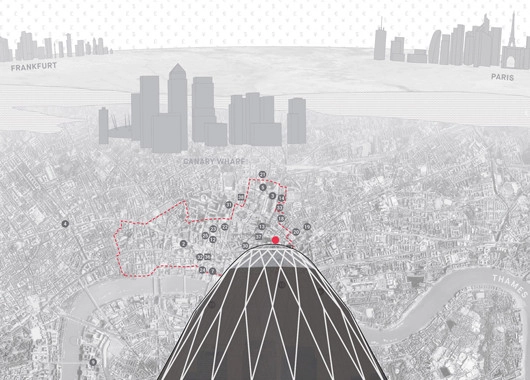
This four part series (originally published on Aggregate’s website) examines the Gherkin, the London office tower designed by Foster + Partners, showing how the urban icon engaged and leveraged perceptions of risk. In part one, author Jonathan Massey introduced the concept of "risk design” to describe how the Gherkin’s design managed the risks posed by climate change, terrorism, and globalization. In parts two and three, Massey examined the building’s treatment of risks associated with climate change and terrorism. In this final installment, Massey concludes by addressing the building’s engagement with risks posed to the City of London by globalization.

Unlike New York and other cities in which zoning codes entitle landowners to some kinds of development “as of right,” the City of London regulates property development through case-by-case review by planning officers, who judge how well the proposed construction conforms to City-wide plans and guidelines regarding factors such as building height, development density, access to transit, and impact on views and the visual character of the area. In order to develop the Gherkin, the property owners and Swiss Re had to secure planning consent from the City Corporation through its chief planning officer, Peter Wynne Rees. The review and permitting process that culminated in the granting of planning consent in August 2000 spanned the planning office as well as the market, the courts, and the press. Rees brokered a multilateral negotiation so intensive that we could almost say the building was designed by bureaucracy. Part of that negotiation entailed imagining and staging risk: climate risk, terrorism risk, and, especially, the financial risks associated with globalization.

The Gherkin: How London’s Famous Tower Leveraged Risk and Became an Icon (Part 3)

Subscriber Access | 

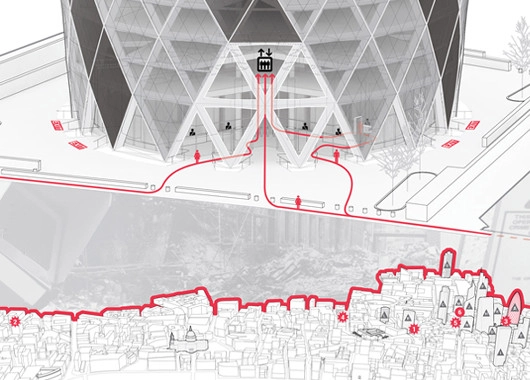
This four part series (originally published on Aggregate’s website) examines the Gherkin, the London office tower designed by Foster + Partners, showing how the urban icon engaged and leveraged perceptions of risk. In part one, author Jonathan Massey introduced the concept of "risk design” to describe how the Gherkin’s design managed the risks posed by climate change, terrorism, and globalization. In part two, Massey examined the building’s treatment of climate risk. In part three, below, he explains how the Gherkin redesigned the risk imaginary associated with terrorism.

Mornings the Zamboni scrubs the plaza. Moving across the pavement in parallel lines connected by tight turns, the sweeper cleans the stone of cigarette butts and spilled food and beer left the night before by the underwriters and bankers who patronize the bar and shops in the building’s perimeter arcade as well as the adjacent restaurant that in fair weather sets up outdoor tables and chairs.

By pulling away from its irregular property lines, the tower achieves almost perfect formal autonomy from its context. The gap between the circular tower base and trapezoidal site boundaries forms a privately owned public space, a civic and commercial amenity in this densely built part of the City. 

The Gherkin: How London’s Famous Tower Leveraged Risk and Became an Icon (Part 2)

Subscriber Access | 

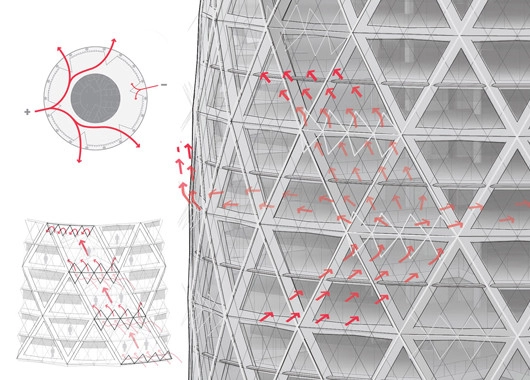
This four part series (originally published on Aggregate’s website) examines The Gherkin, the London office tower designed by Foster + Partners, showing how the urban icon engaged and leveraged perceptions of risk. In part one, author Jonathan Massey introduced the concept of "risk design” to describe how the Gherkin’s design managed the risks posed by climate change, terrorism, and globalization. In part two, below, Massey examines the Gherkin’s enclosure and ventilation systems in detail to explain how the building negotiated climate risk.

In a poster promoting London’s bid to host the Olympic Games, the Gherkin supported gymnast Ben Brown as he vaulted over the building’s conical peak. The image associated British athleticism and architecture as complementary manifestations of daring and skill, enlisting the Gherkin as evidence that London possessed the expertise and panache to handle the risk involved in hosting an Olympic Games.

But a poster created three years later offered a very different image. Created by activists from the Camp for Climate Action to publicize a mass protest at Heathrow Airport against the environmental degradation caused by air travel, this poster shows the Gherkin affording only precarious footing to a giant polar bear that swats at passing jets as its claws grasp at the slight relief offered by spiraling mullions and fins.