1. ArchDaily
  2. Arsomsilp Community and Environmental Architect

Arsomsilp Community and Environmental Architect: The Latest Architecture and News

UIA 2030 Award Announces Regional Finalists of Its Third Cycle Across Five Global Regions

The International Union of Architects (UIA), in partnership with UN-Habitat, has released the Stage 1 results of the third cycle of the UIA 2030 Award, identifying the projects selected as Regional Finalists. The shortlisted entries were drawn from submissions across the UIA's five global regions and will advance to the second stage of evaluation. Established in alignment with the UN 2030 Agenda for Sustainable Development, the award framework positions the built environment within broader discussions on sustainable urban development and global policy objectives.
UIA 2030 Award Announces Regional Finalists of Its Third Cycle Across Five Global Regions - Image 1 of 4UIA 2030 Award Announces Regional Finalists of Its Third Cycle Across Five Global Regions - Image 2 of 4UIA 2030 Award Announces Regional Finalists of Its Third Cycle Across Five Global Regions - Image 3 of 4UIA 2030 Award Announces Regional Finalists of Its Third Cycle Across Five Global Regions - Image 4 of 4UIA 2030 Award Announces Regional Finalists of Its Third Cycle Across Five Global Regions - More Images+ 42

Absorb, Filter, Store: 9 Projects Showcasing How Sponge Cities Adapt to Climate Challenges

Subscriber Access | 

The concept of "sponge cities" has gained prominence since it was introduced by Chinese landscape architect Kongjian Yu, founder of Turenscape, and was officially adopted as a national policy in China in 2013 to combat urban flooding. This approach prioritizes nature-based infrastructure such as wetlands, rain gardens, and permeable pavements, creating landscapes with porous soil where native plants can thrive with minimal maintenance. When it rains, these systems absorb and slow down water flow, reducing flood risks. In contrast, traditional concrete- and pipe-based drainage solutions, though widely used, are costly, rigid, and require frequent maintenance, sometimes even making cities more vulnerable to flooding due to blockages and overflows.

Absorb, Filter, Store: 9 Projects  Showcasing How Sponge Cities Adapt to Climate Challenges - Image 1 of 4Absorb, Filter, Store: 9 Projects  Showcasing How Sponge Cities Adapt to Climate Challenges - Image 2 of 4Absorb, Filter, Store: 9 Projects  Showcasing How Sponge Cities Adapt to Climate Challenges - Image 3 of 4Absorb, Filter, Store: 9 Projects  Showcasing How Sponge Cities Adapt to Climate Challenges - Image 4 of 4Absorb, Filter, Store: 9 Projects  Showcasing How Sponge Cities Adapt to Climate Challenges - More Images+ 5

Step by Step: Exploring 12 Projects Featuring Staircase or Terraced Roof Designs

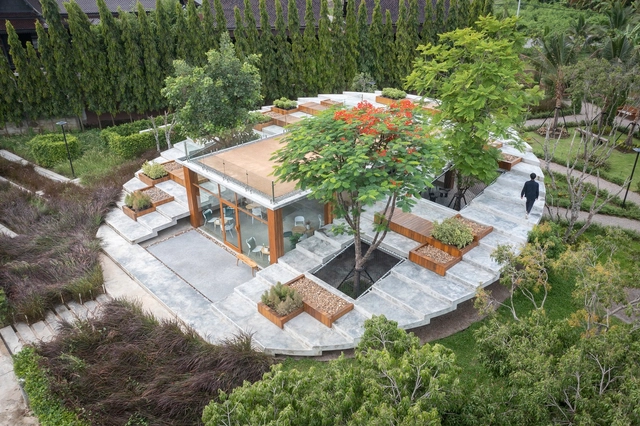
Pitched roofs and terraced lots or hillsides are some of the oldest, yet still highly functional, solutions for rainwater dispersal, redirection, and erosion management. While most constructions today still opt for traditional pitched or flat roofs, advancements in construction materials and techniques are leading to greater design exploration and layout variations. This has resulted in a rise in green roofs, passive insulation solutions, and more innovative uses of rooftops. One particular case has been the recurrence of the staircase or terraced roofs that often bring about a smooth continuity with the site and provide additional functional spaces to the project.

Step by Step: Exploring 12 Projects Featuring Staircase or Terraced Roof Designs - Image 1 of 4Step by Step: Exploring 12 Projects Featuring Staircase or Terraced Roof Designs - Image 2 of 4Step by Step: Exploring 12 Projects Featuring Staircase or Terraced Roof Designs - Image 3 of 4Step by Step: Exploring 12 Projects Featuring Staircase or Terraced Roof Designs - Image 4 of 4Step by Step: Exploring 12 Projects Featuring Staircase or Terraced Roof Designs - More Images+ 34