1. ArchDaily
  2. Energy Technology

Energy Technology: The Latest Architecture and News

How Architecture Is Learning to Generate Its Own Energy

 | Sponsored Content

Beyond being a source of life, the power of the sun in architecture has long been tied to humanity's need to harness and control it as a vital resource. Since ancient times, solar energy has been used to measure time, support planting and harvesting, and provide protection from heat and cold. Today, solar radiation plays a significant role in global energy consumption. Architectural solutions based on materials, technologies, and environmental analysis are developed with an understanding of solar energy's capacity to transform the interior environment of buildings. But how can buildings be transformed into sources of clean energy?

How Architecture Is Learning to Generate Its Own Energy - Image 1 of 4How Architecture Is Learning to Generate Its Own Energy - Image 2 of 4How Architecture Is Learning to Generate Its Own Energy - Image 3 of 4How Architecture Is Learning to Generate Its Own Energy - Image 4 of 4How Architecture Is Learning to Generate Its Own Energy - More Images+ 12

The Technosphere: ArchDaily’s March Editorial Focus

How heavy is a house? In his 1965 essay A Home Is Not a House, Reyner Banham observed that modern American dwellings were becoming structurally lighter while growing heavier in mechanical services, such as plumbing, wiring, heating, and cooling. The true weight of architecture, he argued, was no longer in walls and roofs, but in the energy-intensive systems that sustained comfort.

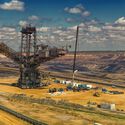
Decades later, the question was updated at the 7th Lisbon Architecture Triennale. Curators Ann-Sofi Rönnskog and John Palmesino asked: How heavy is a city? The scale shifted from the domestic interior to the territory. The technosphere, materialized in the estimated 30 trillion tons of human-made matter on Earth, reframes the discussion entirely. Cities, data centers, oil fields, logistics hubs, satellites, cables, and waste streams form a planetary system in which architecture is neither object nor backdrop, but participant.

The Technosphere: ArchDaily’s March Editorial Focus - Image 1 of 4The Technosphere: ArchDaily’s March Editorial Focus - Image 2 of 4The Technosphere: ArchDaily’s March Editorial Focus - Image 3 of 4The Technosphere: ArchDaily’s March Editorial Focus - Image 4 of 4The Technosphere: ArchDaily’s March Editorial Focus - More Images+ 7

A Bio-Digital Exploration: ecoLogicStudio Opens Deep Forest Exhibition at the Louisiana Museum in Denmark

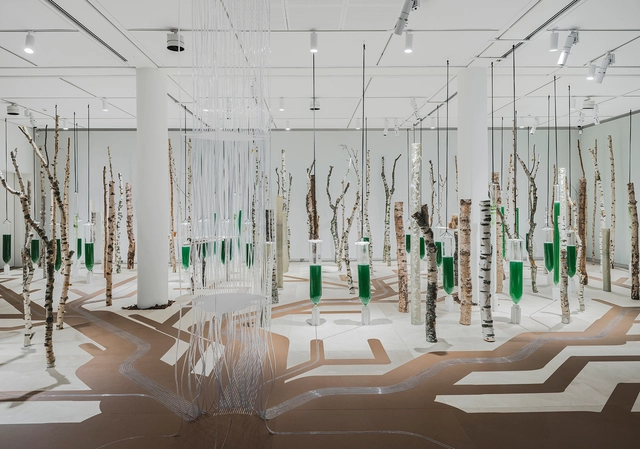
The Louisiana Museum of Modern Art's "Living Structures" exhibition, running from November 8th, 2024, to March 23rd, 2025, features Deep Forest, a new installation by Prof Claudia Pasquero and Dr. Marco Poletto founders of architecture and design innovation firm ecoLogicStudio, together with academic partner Innsbruck University. This immersive work challenges traditional architectural paradigms by embracing the naturalization of architecture and technology, a direct counterpoint to modernist attempts to mechanize nature. The exhibition represents the culmination of twenty years of research in bio-digital design, showcasing the potential of symbiotic relationships between technology and the natural world within built environments.

A Bio-Digital Exploration: ecoLogicStudio Opens Deep Forest Exhibition at the Louisiana Museum in Denmark - Image 1 of 4A Bio-Digital Exploration: ecoLogicStudio Opens Deep Forest Exhibition at the Louisiana Museum in Denmark - Image 2 of 4A Bio-Digital Exploration: ecoLogicStudio Opens Deep Forest Exhibition at the Louisiana Museum in Denmark - Image 3 of 4A Bio-Digital Exploration: ecoLogicStudio Opens Deep Forest Exhibition at the Louisiana Museum in Denmark - Image 4 of 4A Bio-Digital Exploration: ecoLogicStudio Opens Deep Forest Exhibition at the Louisiana Museum in Denmark - More Images+ 27

The Future of Energy: Can Buildings Become Reservoirs of Power?

Subscriber Access | 

Environmental degradation has shed light on the need for new sources of energy. A shift in energy sources calls for innovative means of storing energy. For centuries, buildings have proven able to store people, objects, and systems, inviting a conversation about their untapped potential to efficiently store large amounts of energy. In this new era, can buildings go beyond being structures of function to potential reservoirs of power?

The Future of Energy: Can Buildings Become Reservoirs of Power?  - Image 1 of 4The Future of Energy: Can Buildings Become Reservoirs of Power?  - Image 2 of 4The Future of Energy: Can Buildings Become Reservoirs of Power?  - Image 3 of 4The Future of Energy: Can Buildings Become Reservoirs of Power?  - Image 4 of 4The Future of Energy: Can Buildings Become Reservoirs of Power?  - More Images

Winners of 2021 Solar Decathlon Design and Build Challenges Construct Houses for a Cleaner Future

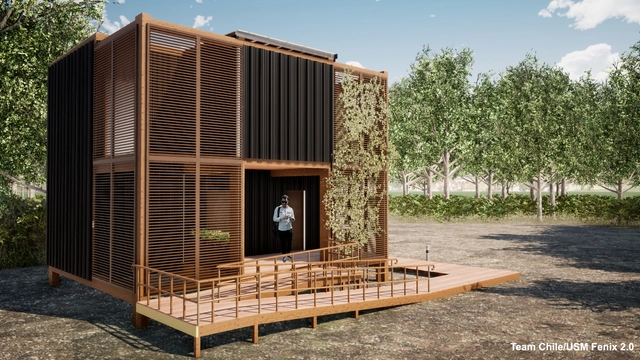
The United States Secretary of Energy Jennifer M. Granholm announced the winners of the 2021 U.S. Department of Energy (DOE) Solar Decathlon, a competition that challenges architecture and engineering college students from around the world to design and construct high-performance buildings powered by renewable energy. 72 competing teams hailed from 12 countries and designed energy-efficient residential and commercial spaces, nine of which were constructed and presented in the Solar Decathlon Virtual Village on the National Mall, a first of its kind, in Washington, D.C.

Winners of 2021 Solar Decathlon Design and Build Challenges Construct Houses for a Cleaner Future  - Image 1 of 4Winners of 2021 Solar Decathlon Design and Build Challenges Construct Houses for a Cleaner Future  - Image 2 of 4Winners of 2021 Solar Decathlon Design and Build Challenges Construct Houses for a Cleaner Future  - Image 3 of 4Winners of 2021 Solar Decathlon Design and Build Challenges Construct Houses for a Cleaner Future  - Image 4 of 4Winners of 2021 Solar Decathlon Design and Build Challenges Construct Houses for a Cleaner Future  - More Images+ 66