1. ArchDaily
  2. HUSOS

HUSOS: The Latest Architecture and News

Beyond Universal Models: The Turn Toward Situated Architecture

Subscriber Access | 

Specificity has re-emerged as a central language in architectural discourse. In an increasingly globalized field, where projects often follow familiar models regardless of context, architects are now turning toward approaches rooted in the particularities of each site. This renewed attention to context reflects broader social, climatic, and political pressures: cities are facing extreme heat, ecological challenges, shifting demographics, and new forms of collective life that demand responses grounded in their immediate conditions.

Situated architecture describes this shift. It refers to design approaches in which form, program, and materiality emerge from the specific environment that produces them: its microclimates, cultural structures, and everyday rituals. Rather than beginning with universal templates, these practices start with observation, prototyping, and direct engagement with local dynamics. This logic is visible in the climatic and material experiments of TAKK in Spain, such as Portable Garden and 10k House, which operate as lightweight prototypes tuned to thermal and ecological gradients; in Studio Ossidiana's Art Pavilion M, shaped by layered soils and ecological cycles in the Netherlands; in Izaskun Chinchilla's reinterpretations of vernacular objects and her later experiments with 100 Sillas and 3 Salones Urbanos; in the narrative-driven domestic spaces explored by Common Accounts; and in Raumlabor's urban interventions that respond directly to the specificities of post-industrial Berlin.
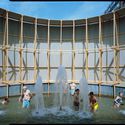
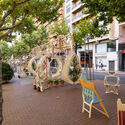
Beyond Universal Models: The Turn Toward Situated Architecture - Image 1 of 4Beyond Universal Models: The Turn Toward Situated Architecture - Image 2 of 4Beyond Universal Models: The Turn Toward Situated Architecture - Image 3 of 4Beyond Universal Models: The Turn Toward Situated Architecture - Image 4 of 4Beyond Universal Models: The Turn Toward Situated Architecture - More Images+ 56

Beyond Human-Centered Architecture: Designing Spaces with Other Species

Subscriber Access | 

As architecture moves beyond human-centered design, new practices are rethinking coexistence as an ethical and ecological framework. From political infrastructures to habitats, these approaches invite us to imagine architecture as a shared living system.

Modern architecture has long been written through an anthropocentric lens, placing the human at its center and rendering other species invisible. Yet this paradigm continues to shift, as architects and researchers redefine the role of design in more-than-human worlds. Studios such as Office for Political Innovation, Studio Ossidiana, and Husos Architects are questioning human-centered narratives and reframing design as a shared practice between species. In this context, architecture is no longer a tool of control but a medium for coexistence, a discipline that mediates between species, environments, and cultures.

Beyond Human-Centered Architecture: Designing Spaces with Other Species - Image 6 of 4Beyond Human-Centered Architecture: Designing Spaces with Other Species - Image 10 of 4Beyond Human-Centered Architecture: Designing Spaces with Other Species - Image 23 of 4Beyond Human-Centered Architecture: Designing Spaces with Other Species - Image 4 of 4Beyond Human-Centered Architecture: Designing Spaces with Other Species - More Images+ 23

A Catalyst for Social Change and Equity: In Conversation with Holcim Award Winners Husos, Elli, and Ultrazul

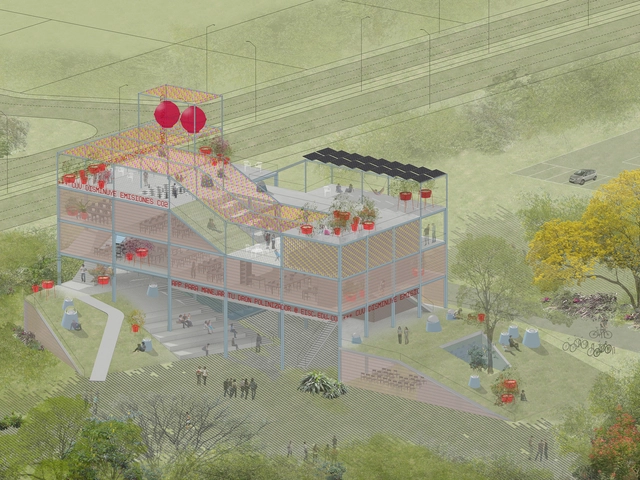
The Holcim Foundation for Sustainable Construction announced the winners of the 2023 edition, celebrating projects that showcase innovative approaches to sustainable construction practices. For the Europe region, the Gold Prize was awarded to Husos, Elli, and Ultrazul for their project “Composition of Knowledge House.” In a video interview with the winners, they explain the details of this rehabilitation project. Developed for the Carasso Foundation headquarters, the project uses an innovative “360° co-design process” to promote inclusivity and community involvement.

A Catalyst for Social Change and Equity: In Conversation with Holcim Award Winners Husos, Elli, and Ultrazul - Image 1 of 4A Catalyst for Social Change and Equity: In Conversation with Holcim Award Winners Husos, Elli, and Ultrazul - Image 2 of 4A Catalyst for Social Change and Equity: In Conversation with Holcim Award Winners Husos, Elli, and Ultrazul - Image 3 of 4A Catalyst for Social Change and Equity: In Conversation with Holcim Award Winners Husos, Elli, and Ultrazul - Image 4 of 4A Catalyst for Social Change and Equity: In Conversation with Holcim Award Winners Husos, Elli, and Ultrazul - More Images+ 2

Winners Announced for the 2023 International Holcim Awards

The Holcim Foundation for Sustainable Construction has revealed the winning projects for the Holcim Awards 2023 competition, as well as the silver, bronze, and acknowledgement prizes, at a ceremony on November 18 in Venice, Italy. Evaluated by a jury comprising five independent expert panels from around the world, these projects were chosen to highlight contextual and practical approaches to sustainable construction, showcasing diversity across scales, budgets, geographies, and forms. On another hand, Francis Kéré winner of the Global Holcim Gold in 2012 and Laureate of the Pritzker Architecture Prize in 2022 took the stage at the event to talk about the influence of the Holcim Award on his career.

DnA_Design and Architecture Studio took home the golden prize for Asia-Pacific for an adaptive reuse project of a heritage building, while Husos, Elii, and Ultrazul won for Europe with a 360° co-design process for the rehabilitation of an industrial building. For the Latin American territory, Cano Vera Arquitectura was selected for an urban forest and social infrastructure precinct, and for the MEA region, Juergen Strohmayer and Glenn DeRoché were praised for a youth empowerment and responsible tourism cooperative. Finally, Partisans Architects and Well-Grounded Real Estate won the first prize for North America with a high-tech and low-cost modular housing solution for urban living.

Winners Announced for the 2023 International Holcim Awards - Image 1 of 4Winners Announced for the 2023 International Holcim Awards - Image 2 of 4Winners Announced for the 2023 International Holcim Awards - Image 3 of 4Winners Announced for the 2023 International Holcim Awards - Image 4 of 4Winners Announced for the 2023 International Holcim Awards - More Images+ 21

Holcim Foundation for Sustainable Construction Announces Finalists for the 2023 International Holcim Awards

The Holcim Foundation for Sustainable Construction has unveiled the list of 20 finalists for the Holcim Awards 2023 competition. The jury, composed of five independent expert panels worldwide, has selected the projects to showcase contextual and practicable approaches to sustainable construction, exemplifying a diverse range of scales, budgets, geographies, and forms. The ranking of the nominees will be announced at the Holcim Awards 2023 Ceremony scheduled for November 18 in Venice, Italy during the final weeks of the Biennale Architettura 2023 - 18th International Architecture Exhibition.
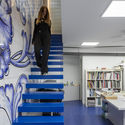
Holcim Foundation for Sustainable Construction Announces Finalists for the 2023 International Holcim Awards - Image 1 of 4Holcim Foundation for Sustainable Construction Announces Finalists for the 2023 International Holcim Awards - Image 2 of 4Holcim Foundation for Sustainable Construction Announces Finalists for the 2023 International Holcim Awards - Image 3 of 4Holcim Foundation for Sustainable Construction Announces Finalists for the 2023 International Holcim Awards - Image 4 of 4Holcim Foundation for Sustainable Construction Announces Finalists for the 2023 International Holcim Awards - More Images+ 16

Husos Architects: "We Don't Want to Contribute to the Homogenization of the World Around Us"

Husos Architects' work advances in an ongoing dialogue between design and research. Founded in 2003 between Spain and Colombia, the architecture and urban planning office stands out for addressing different scales, from the micro to the global, responding to the requirements of specific users but weaving deep contextual networks with the environment and beyond. How do they effectively approach this complexity, in turn promoting social transformation? We spoke with Diego Barajas and Camilo García Barona about their processes of approaching users and other agents involved –not only humans–, about how they address the colonization of the biosphere that has caused climate change, and about their inquiry into activism from a series of battlefields habitually neglected in traditional discourses of architecture.

Blurring the Line Between Architecture and Furniture

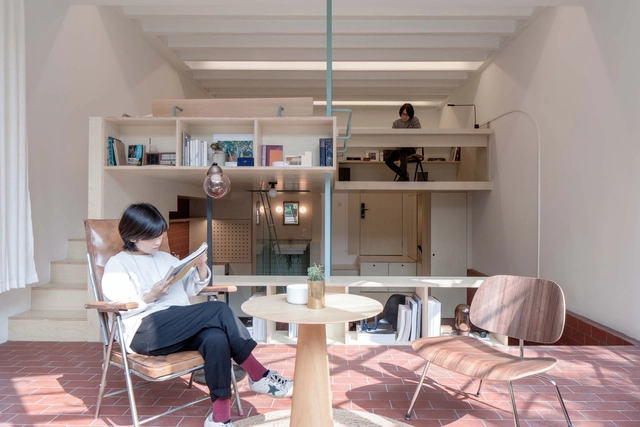
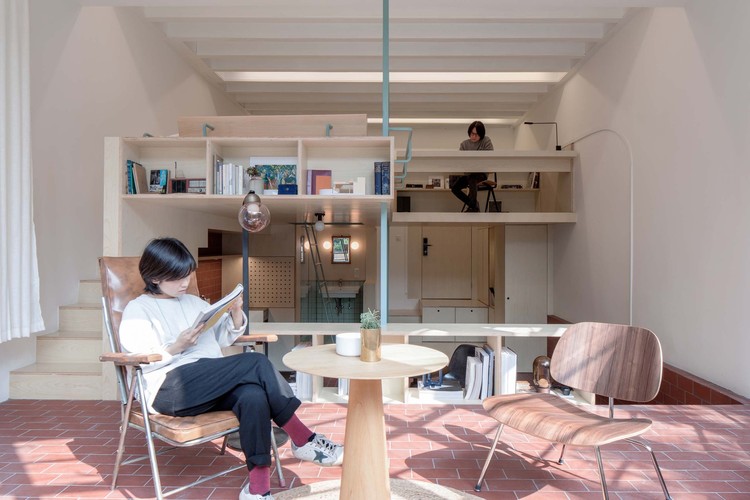
An emerging design trend is filling the gap between furniture and architecture by shaping space through objects at the intersection of the two, creating a dynamic and highly adaptable environment. Either a consequence of the increased demand for flexibility in small spaces or the architectural expression of a device-oriented society, elements in between architecture and furniture open the door towards an increased versatility of space. Neither architecture nor furniture (or perhaps both), these objects operate at the convergence of the two scales of human interaction, carving a new design approach for interior living spaces.

Blurring the Line Between Architecture and Furniture - Films & ArchitectureBlurring the Line Between Architecture and Furniture - Films & ArchitectureBlurring the Line Between Architecture and Furniture - Films & ArchitectureBlurring the Line Between Architecture and Furniture - Films & ArchitectureBlurring the Line Between Architecture and Furniture - More Images+ 5

Explore Madrid's Design Studios Through the Lens of Marc Goodwin

Subscriber Access | 

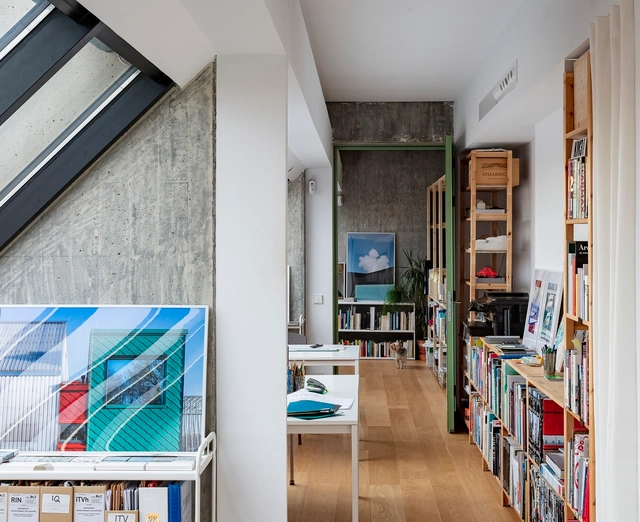
Architectural photographer Marc Goodwin recently visited Madrid to continue his journey documenting diverse architecture studios and design offices. He has visited many cities and countries around the world, including Brazil, Panama City, the Netherlands, Dubai, London, Paris, Beijing, Shanghai, Seoul, the Nordic countries, Barcelona, Los Angeles and Istanbul. In Madrid, Marc photographed 16 intimate office spaces and a range of studios.

Explore Madrid's Design Studios Through the Lens of Marc Goodwin - Image 1 of 4Explore Madrid's Design Studios Through the Lens of Marc Goodwin - Image 2 of 4Explore Madrid's Design Studios Through the Lens of Marc Goodwin - Image 3 of 4Explore Madrid's Design Studios Through the Lens of Marc Goodwin - Image 4 of 4Explore Madrid's Design Studios Through the Lens of Marc Goodwin - More Images+ 28

Bioclimatic Prototype of a Host and Nectar Garden Building / Husos Architects

Bioclimatic Prototype of a Host and Nectar Garden Building  / Husos Architects - HousingBioclimatic Prototype of a Host and Nectar Garden Building  / Husos Architects - HousingBioclimatic Prototype of a Host and Nectar Garden Building  / Husos Architects - HousingBioclimatic Prototype of a Host and Nectar Garden Building  / Husos Architects - HousingBioclimatic Prototype of a Host and Nectar Garden Building  / Husos Architects - More Images+ 42

  • Architects: Husos Architects
  • Area Area of this architecture project Area:  510
  • Year Completion year of this architecture project Year:  2012
  • Manufacturers Brands with products used in this architecture project
    Manufacturers:  Holcim, Acesco, Icomallas, Pallomaro, Pintuco