1. ArchDaily
  2. Salagnac Architectos

Salagnac Architectos: The Latest Architecture and News

Tropical Hotels in Costa Rica: Six Projects to Explore Climate-Sensitive Architecture in Central America

Subscriber Access | 

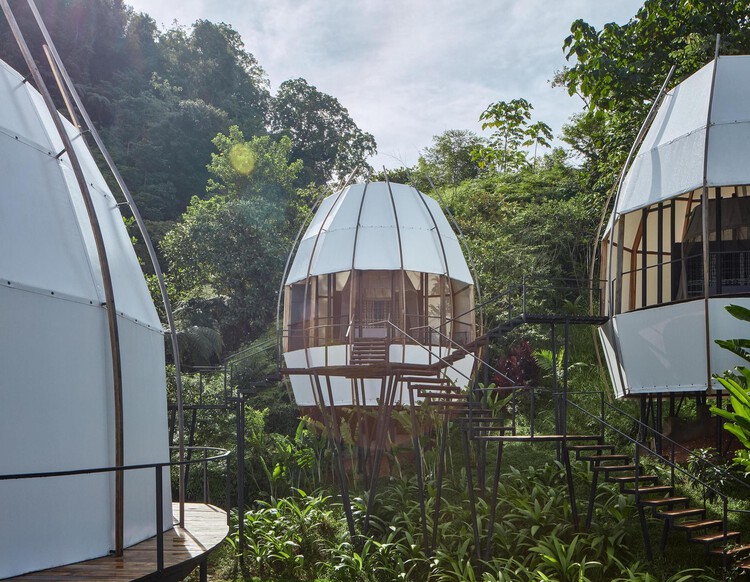
In the coastal and jungle regions of Costa Rica, high humidity and intense solar radiation dictate an architectural strategy centered on permeability rather than enclosure. Unlike the airtight envelopes required in cold climates to retain heat, Costa Rican architecture uses the building envelope as a climatic filter to maximize air exchange. The primary mechanism for managing these thermal gradients seems to be the oversized roof overhang. By extending the roof plane significantly beyond the floor plate, architects create a permanent buffer of deep shade that reduces solar gain and lowers the ambient temperature before air enters the structure. This strategy, combined with permeable or non-existent walls, allows for constant airflow. This is a critical technical requirement for humidity control and the prevention of material degradation through mold and rot.

Tropical Hotels in Costa Rica: Six Projects to Explore Climate-Sensitive Architecture in Central America - Image 1 of 4Tropical Hotels in Costa Rica: Six Projects to Explore Climate-Sensitive Architecture in Central America - Image 2 of 4Tropical Hotels in Costa Rica: Six Projects to Explore Climate-Sensitive Architecture in Central America - Image 3 of 4Tropical Hotels in Costa Rica: Six Projects to Explore Climate-Sensitive Architecture in Central America - Image 4 of 4Tropical Hotels in Costa Rica: Six Projects to Explore Climate-Sensitive Architecture in Central America - More Images+ 4

Nosara Recycling Plant / sLAB

Subscriber Access | 

A small group of students and architect Tobias Holler of sLAB Costa Rica at the New York Institute of Technology, have teamed up to design and build a communal recycling center for Nosara, Costa Rica – a city that is facing grave problems with sanitation and illegal dumping of garbage on beaches and in wildlife areas. Construction started last summer after a Kickstarter campaign that raised $15,000 helped provide expenses and costs associated with housing the students that assisted with the construction. A relaunch of the Kickstarter campaign will provide the project with additional funds to bring the students back to accelerate the pace of construction. The funds also support the documentary by Ayana de Vos, whose film follows the progress of the project and features waste management and sustainability in Costa Rica.

Join us after the break for more.

The motivation behind building a Communal Recycling Center is based in the severe problems that Nosara specifically, and Costa Rica in general, has in municipal waste management. Without appropriate infrastructure and policies, over 1400 tons of waste is deposited into unregulated dumps daily. A lot of the garbage makes its way into rivers and forests, pollutes ground water, threatens the health of local communities and destroys wildlife.