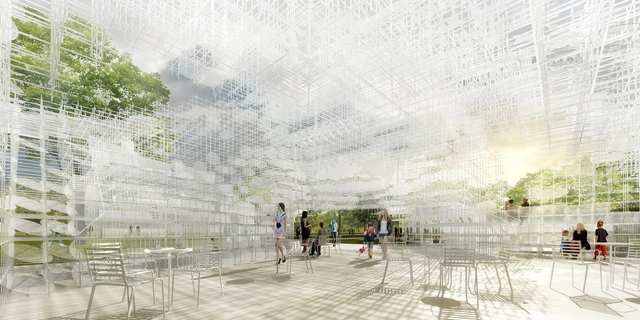
Last week an online call was put out by Rome'sMAXXI museum promising the first five architecture students to respond a chance to travel to Rome and build a model of Sou Fujimoto's latest project. The five selected entrants started on their work at MAXXI on Monday and their experience is being broadcast over the course of this week in a series of photos and videos detailing the ups, downs, opinions and thoughts of the students as they work.
Read more about the model and exhibition after the break...
Videos
Serpentine Gallery Pavilion 2013 Designed by Sou Fujimoto Interior Indicative CGI
Today, the Serpentine Gallery announced the architect that will design the 13th edition of the Serpentine Gallery Pavilion. Every year the gallery invites a renowned international architects who have not built yet in the UK, to design a temporary pavilion that hosts public activities in at the Gallery’s lawn, in London’s Hyde Park between June and October. The list of architects for the past editions includes several Pritzker laureates. More info of this program at our Serpentine Gallery Pavilion infographic.
The works of Sou Fujimoto resist any form of conventional categorization. This young Japanese architect stands for unconventional buildings that cannot be described by standard criteria and definitions such as inside/outside or public/private. Clear divisions such as between floor levels and rooms are shattered by his complex ground plans and interlocking structures which—in a reference to the idea of the cave—he describes as “Primitive Future.” With this approach he creates forms that are committed to a playful interaction between user and space. Alongside private residences, such as the well-known N House, his library for Musashino Art University has achieved particular recognition. In addition he was represented at the 2010 Venice Biennale with a design for a house.
Sou Fujimoto Architects have shared with us their first place proposal for the Beton Hala Waterfront Centre in Belgrade, Serbia. Contrasting the medieval fabric of the capital city, Sou Fujimoto’s “floating cloud” intertwines an array of social and transportation programs into an organized tangle of suspended ramps that emerge from the static platform of the Beton Hala. It was lauded by the jury to be a “brave proposal” that holds the “highest emblematic potential among all of Beton Hala entries”.
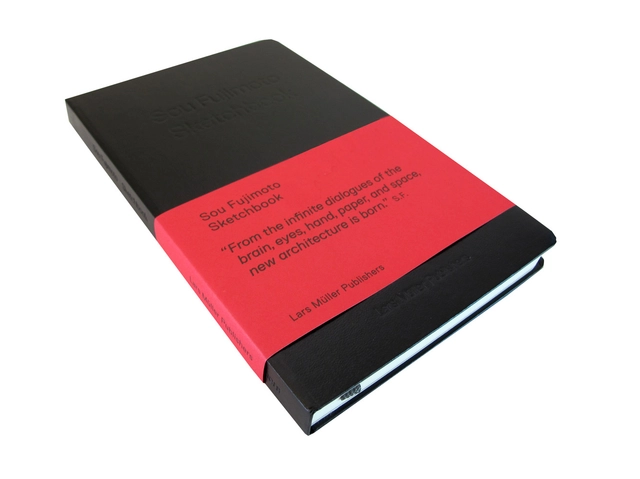
Join the authors and editors of Lars Müller Publishers for a rare book signing opportunity with architects Wang Shu, Sou Fujimoto, and Steven Hollon August 28th at the 2012 Venice Architecture Biennale! This event will kick off the exhibition Lars Müller Publishers – Book Fever, which will feature sixty publications – new releases, bestsellers, milestones from the past, and rare treasures – for the public to explore.
Founded thirty years ago, Lars Müller Publishers’ carefully edited and designed publications on architecture, design, and contemporary art has lead them to become a renowned international publisher. One milestone you may remember was their release of Peter Zumthor’s Works (1998), which was the first survey of the oeuvre of the architect now known worldwide that set new standards for the monograph as a book genre.
Continue after the break for more details on the book signing and exhibition.
Shinkenchiku brings you an exclusive inside tour of the contemporary House NA, designed by Sou Fujimoto Architects. Thin, steel poles delicately support the transparent “pile of boxes” at varying heights. In an interview conducted by F.W. Monocle, Sou Fujimoto explains, “In one way the house is like a single space, but each room is also a tiny space of its own. The clients said they wanted to live like nomads within the house – they didn’t have specific plans for each room. The house looks radical but for the clients it seemed quite natural.”
The Internet is now the library of the past. Where the public library has historically served as the primary source of information gathering and dissemination, we now look to this new virtual, infinitely large library that can be accessed anywhere at any time as the Library of the present.
As a result, the primary roles of today’s physical libraries have shifted. Libraries of the past focused primarily on individualized information consumption. Communal aspects of interaction and information dissemination now represent the core mission of the library when information is more easily accessible. The silent grand beaux-arts reading rooms of New York or Boston have of the past been transformed into flexible communal “living rooms” in Seattle.
The new library, placed centrally at the Dalarna university campus, is organized as a ”spiral of knowledge” (see diagram below). The sloping terrain continues in a ramp through the building. Wrapping itself the ramp creates a spiral-shaped space – the heart of the building for information seeking and easy orientation. This organization of program creates a various learning environment where students can take part in the vibrant life of the library as well as retreat into various study niches. The different sound levels and activities create a diverse and eventful library.