1. ArchDaily
  2. Wang Shu Amateur Architecture Studio

Wang Shu Amateur Architecture Studio: The Latest Architecture and News

On the Work of Three Pioneering Chinese Architects: Wang Shu, Yung Ho Chang, and Liu Jiakun

I first went to China in 2002, a year after the International Olympic Committee awarded the 2008 Summer Games to Beijing. That initial trip was about exploring nature, cuisine, ancient temples, archeological sites, and, in general, experiencing lifestyles in China, mainly outside of its major cities. I was motivated by the pure curiosity of a Western tourist driven to an Eastern country in search of the old world, the exotic, hoping to catch a glimpse of a rich traditional culture on the cusp of its inevitable radical transformation. At the time, there was no modern, or rather contemporary, architecture in China to speak of. There were only the promising first hints of the development of a potentially new architectural language being undertaken by just a handful of independent architects almost entirely under the radar.

On the Work of Three Pioneering Chinese Architects: Wang Shu, Yung Ho Chang, and Liu Jiakun - Image 1 of 4On the Work of Three Pioneering Chinese Architects: Wang Shu, Yung Ho Chang, and Liu Jiakun - Image 2 of 4On the Work of Three Pioneering Chinese Architects: Wang Shu, Yung Ho Chang, and Liu Jiakun - Image 3 of 4On the Work of Three Pioneering Chinese Architects: Wang Shu, Yung Ho Chang, and Liu Jiakun - Image 4 of 4On the Work of Three Pioneering Chinese Architects: Wang Shu, Yung Ho Chang, and Liu Jiakun - More Images+ 19

Witnessing the Growth of Xiangshan Campus of China Academy of Art: 2007 vs 2021

Subscriber Access | 

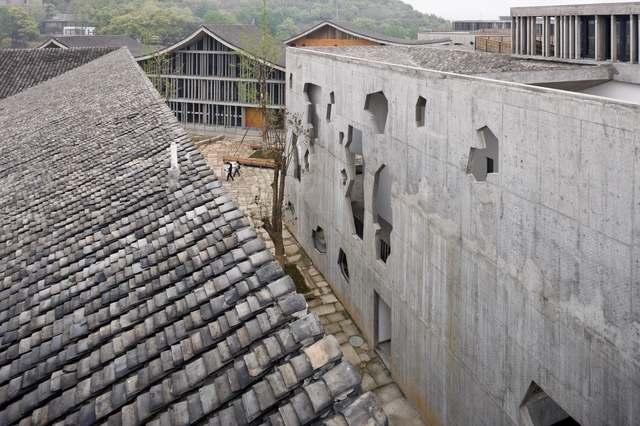
The Xiangshan campus of China Academy of Art was designed by the recipient of the 2012 Pritzker Architecture Prize, Shu Wang and Wenyu Lu from Amateur Architecture Studio. The studio was responsible for the overall project completion from master planning to architectural design and landscape design. On the north side of Xiangshan is the first phase of the campus. It was designed in 2001 and completed in 2004. It is a complex of ten buildings and two bridges, with a construction area of about 70,000 square meters. The second phase of the campus is located on the south side of Xiangshan, and it was designed in 2004 and completed in 2007. It consists of ten large buildings and two small buildings with a construction area of nearly 80,000 square meters.

The construction period of the two phases was 14 months each. A large number of craftmanship during the construction has produced many problems that could only be solved on-site, therefore the site was repeatedly touched and shaped by countless hands. In 2007, the photographer Iwan Baan recorded the campus after completion. In 2021, photographer Sai Zhao used the lens of original focal length to take pictures of the campus at the same location. Over the course of more than ten years, green plants have covered and sheltered the structure, and the building now has its own life.

Selected Projects of Pritzker Laureates’ in 2020

This year, architecture’s highest honor, the Pritzker Prize, has been granted to Grafton Architects, a Dublin-based architectural firm mainly ran by female partners Yvonne Farrell and Shelley McNamara. For the first time ever in its 42-year history, due to the constraints set by Covid-19 global pandemic, the organizers of the Pritzker Prize decided to use Livestream the award ceremony. Having reached the end of 2020, ArchDaily has summed up what current and previous Pritzker Prize winners have accomplished during this turbulent year.