

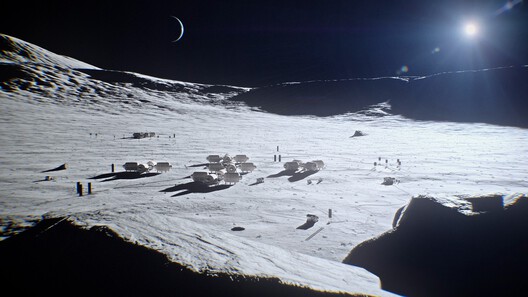
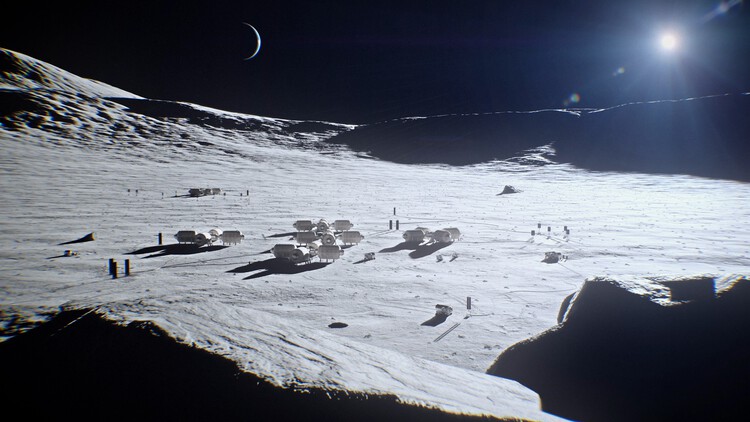
After Artemis II's return to Earth, NASA unveiled a new phased plan to establish a Moon Base. Although most of the media's attention went to rockets, budgets, and geopolitical competition, a quieter question was lingering for architects in the background: How can a human being actually live on the surface of the Moon, and for how long? The establishment of a permanent human presence on the Moon marks a fundamental shift in space exploration that requires a new architectural paradigm. In their presentation, NASA officials suggested the strategy would drift away from highly constrained, vehicle-dependent environments toward autonomous, site-adaptive, and eventually permanently habitable structures.


The architectural design of a permanent lunar outpost is dictated by the radical environmental constraints of the lunar environment, specifically its South Pole. Within this area, NASA has set its interest around the Shackleton crater and its Connecting Ridge. Unlike terrestrial environments, where the atmosphere mitigates thermal extremes, the lunar surface lacks an atmosphere. Structures must withstand external temperatures fluctuating between 120ºC during periods of illumination and -130ºC during the lunar night, while regions permanently in shadow can reach -250ºC.

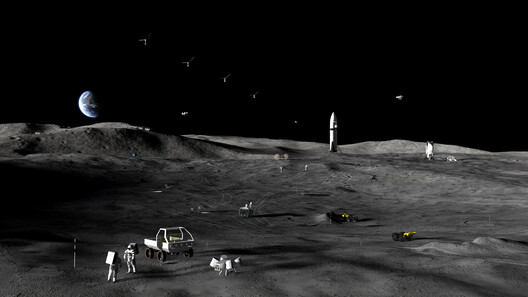
The absence of an atmosphere means architects must think in opposition to Earth-based design methodology. Sunlight in this environment will be harmful, so habitats with no windows will probably be the go-to strategy to prevent unnecessary or unprotected exposure. At the same time, because the low angle of solar illumination at the poles creates elongated shadows, site layouts must optimize the positioning of vertical solar collectors on elevated ridges while placing primary habitats adjacent to permanently shadowed regions (PSRs) to leverage potential resources like water ice. Additionally, architects must also plan for other site conditions: continuous micro-meteoroid bombardment and cosmic radiation.
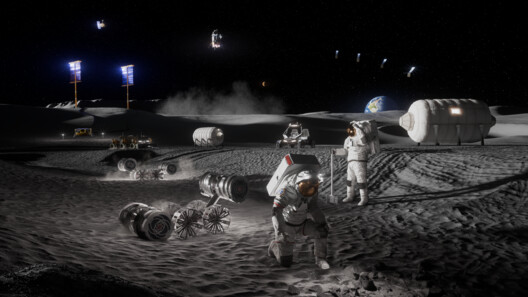
In that sense, the plan will start with phase one. This operation will focus on mobile architecture and autonomous site-mapping units. Concretely, two mobility systems were mentioned: the Lunar Terrain Vehicle (LTV) and the Flexible Logistics and Exploration (FLEX) rover. From an architectural perspective, these vehicles are the first mechanical interventions on the site. They need to be capable of enduring 150 hours of continuous shadow and navigating regolith (lunar dust), which may cause severe mechanical wear. Simultaneously, autonomous mapping drones will generate high-resolution digital terrain models. This topographic data will help identify soil stability, slope gradients, and excavation zones required before any static foundation elements can be anchored to the surface.
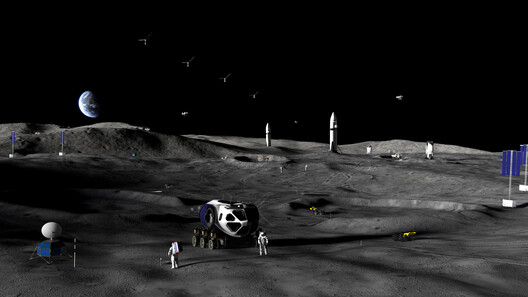
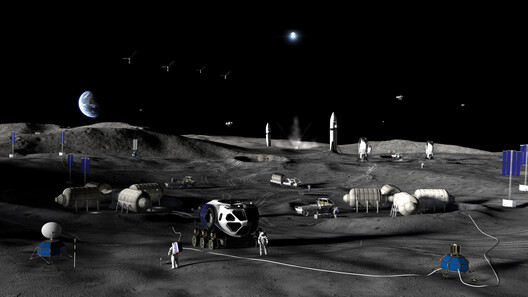
Phase two will lead the transition to early habitation by introducing mobile enclosures that serve as pressurized, shirt-sleeve environments. The Japan Aerospace Exploration Agency (JAXA) and Toyota's pressurized rover, called the Lunar Cruiser, represents a dual architectural typology: it functions simultaneously as a primary laboratory and a temporary residential dwelling for two occupants for up to 30 days. The pressurized rover is intended to provide a safe, enclosed workspace where astronauts can live, conduct research, and prepare for surface excursions. In terms of surface infrastructure, independent power modules are also required. This phase will also test the deployment of solar power systems and initial nuclear surface power capabilities for future settlements.
Finally, phase three introduces the first semi-permanent human habitat. It will consist of large habitation modules linked via specialized structural nodes and rigid airlocks. The spatial layout is designed for long-duration comfort, separating active workspace zones from quiet residential quarters. To maintain a constant internal pressure against the external vacuum of space, these structures utilize rigid metallic or inflatable multilayer shells. The primary architectural challenge is protecting these modules from the thermal and radiation environment. This is achieved by planning for autonomous logistics rovers to construct external protective barriers over the modules, ensuring structural integrity and long-term material survivability over a projected 10-year lifespan.
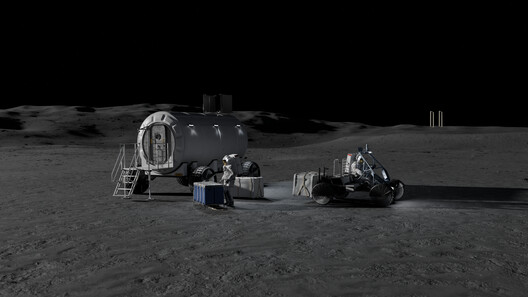
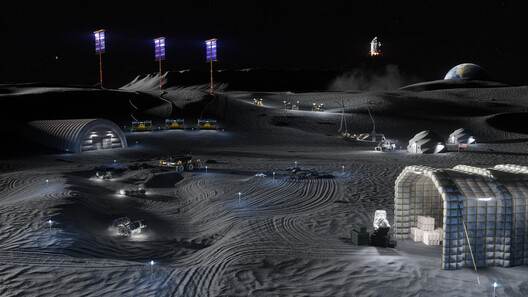
The long-term viability of future lunar architecture depends on In-Situ Resource Utilization (ISRU) to eliminate dependency on Earth-delivered mass. Civil engineering on the Moon will focus on processing raw lunar regolith into building materials. Robotic systems use sintering, applying microwave or laser heat to fuse regolith particles, and 3D printing to construct horizontal infrastructure like landing pads, roads, and blast walls. Furthermore, regolith is mechanically piled or corbelled over the habitation modules to form a thick, protective blanket. However, no clear strategy is yet planned for lunar agriculture. For the time being, NASA only plans to expand end-to-end logistics capabilities to deliver essential supplies and infrastructure, including food, water, clothing, and spare parts.
Establishing a permanent presence on the Moon depends entirely on the logical progression of its architecture. By moving systematically from robotic data collection to mobile, pressurized habitats, and finally to fixed, regolith-shielded structures, the outpost transitions from a temporary shelter to a semi-permanent facility. The integration of local resources through 3D printing and sintering demonstrates that the long-term viability of lunar architecture relies on one of architecture's oldest principles: using the environment itself rather than resisting it. Ultimately, the lessons learned from building on the lunar South Pole will establish the baselines required to expand human habitation farther into the solar system.
This article is part of the ArchDaily Topic: Transspecies Architecture: The Life of Materials, Ecological Alliances, and Nature's Agency. Every month we explore a topic in-depth through articles, interviews, news, and architecture projects. We invite you to learn more about our ArchDaily Topics. And, as always, at ArchDaily we welcome the contributions of our readers; if you want to submit an article or project, contact us.


