1. ArchDaily
  2. North America

North America: The Latest Architecture and News

12 Projects Win North American Copper in Architecture Awards

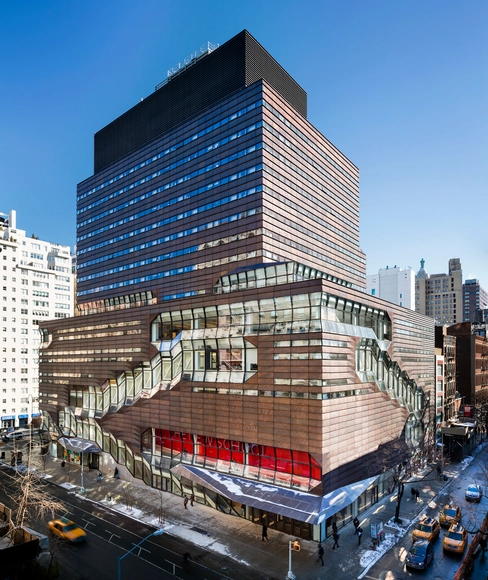
The Copper Development Association (CDA) has announced its selections for the 2015 North American Copper in Architecture Awards (NACIA), now in their eighth year. The awards celebrate stellar projects that incorporate copper in their designs. The 12 award-winning works span three categories and include educational, residential and healthcare buildings in addition to historic landmarks.

Winners were selected by a panel of industry professionals based on their overall design, incorporation and treatment of copper, and distinction in either innovation or historic restoration. 

12 Projects Win North American Copper in Architecture Awards - Image 1 of 412 Projects Win North American Copper in Architecture Awards - Image 2 of 412 Projects Win North American Copper in Architecture Awards - Image 3 of 412 Projects Win North American Copper in Architecture Awards - Image 4 of 412 Projects Win North American Copper in Architecture Awards - More Images+ 8

Lateral Office's 2014 Venice Biennale 'Arctic Adaptations' Exhibition To Tour Canada

Lateral Office's Arctic Adaptations exhibition, which was recognised with a Special Mention at the 2014 Venice Biennale, will travel make its debut in Canada at the Winnipeg Art Gallery this week before heading to Whitehouse, Vancouver, and Calgary. The exhibition "surveys a century of Arctic architecture, an urbanising present, and a projective near future of adaptive architecture in Nunavut" though interactive models, photography, and topographical maps of the twenty five communities of the area, as well as Inuit carvers’ scale models of some of the most recognised buildings in the territory. In addition, it proposes a future of adaptive and responsive architecture for Canada's northern territories.

The Canadian Museum for Human Rights: "Failed Memorial and White Elephant"?

In an article for The Walrus, Adele Weder examines Antoine Predock's (who was recently made a National Academy Academician) Canadian Museum for Human Rights: a "colossal, twelve-storey mountain of concrete and stone, 120,000 square feet of tempered glass, and 260,000 square feet of floor space." Early advocates of the museum "felt that Winnipeg was ripe for such a statement piece," just as Bilbao had been for the Guggenheim. Welder's explorations are clear and concise, finding all sorts "of paradoxes swirling around the Museum for Human Rights." Noting that "it’s definitely a kick-ass building, with its aggressive outer form, jagged paths inside, big black slabs of basalt, thick sheets of glass, and the huge metal girders that hold it all together," Weder argues that it's position as a "failed memorial and white elephant" may be it's eventual undoing.

VIDEO: What We Can Learn From Tall Buildings

Subscriber Access | 

What do you think the North American, Asian and Western European tall building communities most need to learn from each other? This is precisely what the Center on Tall Buildings and Urban Habitat (CTBUH) sat down to ask five leading architects, whose responses formed an eclectic and meaningful overview on the state of tall building worldwide. As Rem Koolhaas noted, each region has their own journey that is worth understanding, such as the Arab world’s transition from “extravagance to rationality” or Asia’s hyper-focus on project realization. But, as James Goettsch points out, “not every building has to be something remarkable." It’s alright for some buildings to be nothing more than “good citizens.”

United North America / Holm Architecture Office

Subscriber Access | 
United North America / Holm Architecture Office - Image 4 of 4
USA - Canada border, Jens Holm, Holm Architecture Office (HAO) in collaboration with Harold Gainer, Neurolapse.